Solid Teak Wood Four Poster Bed with Barley Twist Posts: The Complete Buyer's Guide
Hand-turned barley twist posts, a padded camelback headboard and seasoned solid teak: everything to know before commissioning an heirloom four poster bed.
In one paragraph
The Solid Teak Wood Four Poster Bed by Maison Areeba on 1Antiq is a made-to-order heirloom bed with hand-turned barley twist posts, acorn finials and an upholstered camelback headboard. It costs ₹6,50,000 (from ₹9,50,000), is built in 4–6 weeks from seasoned solid teak, needs no box spring, ships free and tracked, and is available in King, Queen and custom sizes.
Quick answer
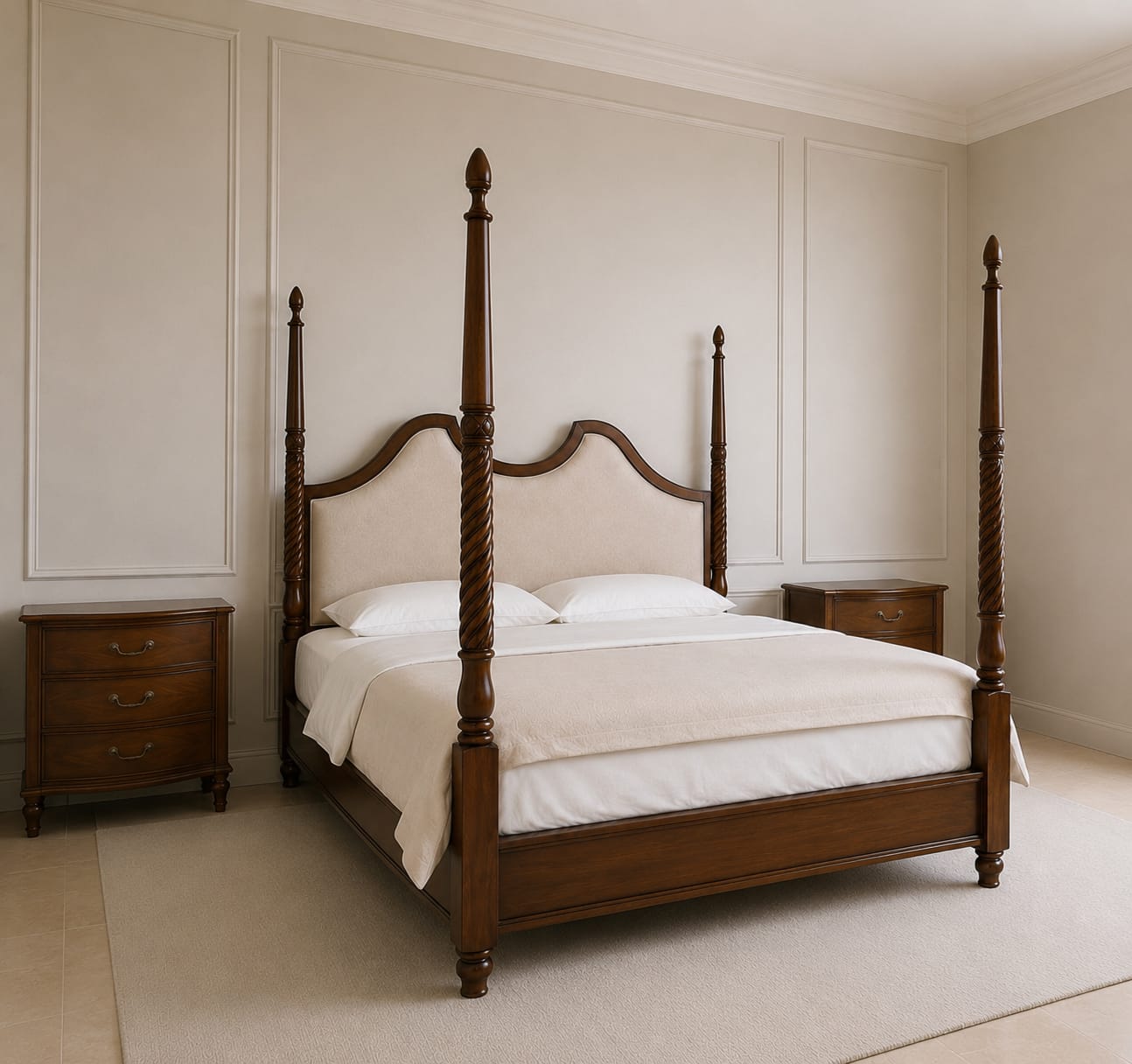
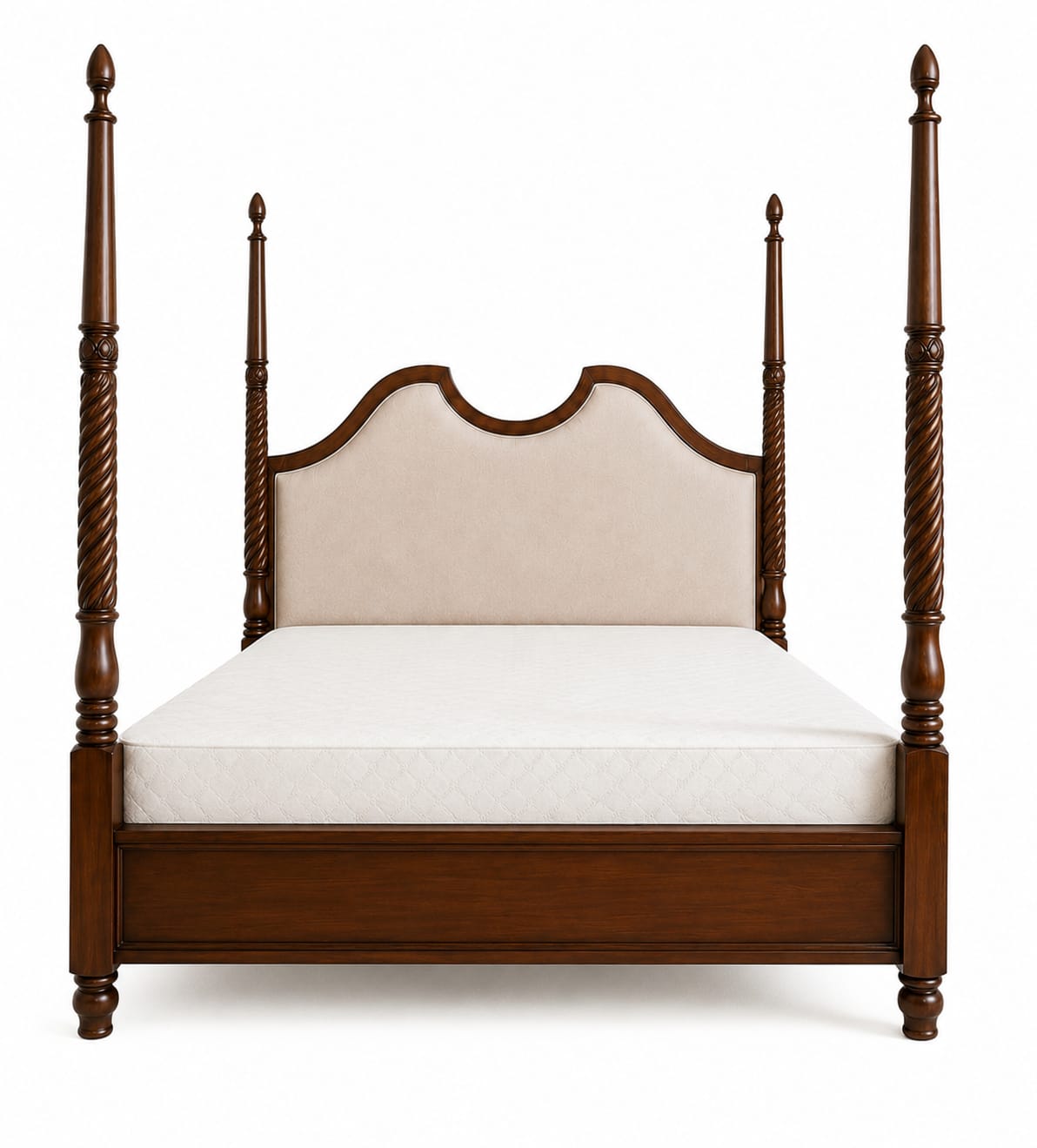
The Solid Teak Wood Four Poster Bed with barley twist posts and an upholstered camelback headboard is a made-to-order heirloom bed hand-built by Maison Areeba, a verified workshop on 1Antiq. It is carved from seasoned solid teak, stands on four tapered posts finished with acorn finials, and carries a serpentine (camelback) upholstered headboard for comfortable reading. It is priced at ₹6,50,000 (down from ₹9,50,000), ships free and tracked across India, is available in King, Queen and fully custom sizes, and takes 4–6 weeks to craft plus 5–7 business days of processing. It needs no box spring — solid wooden slats support the mattress directly.
Best for: high-ceilinged master bedrooms, heritage bungalows, farmhouse and transitional interiors, and buyers who want a bed that will outlive the room around it.
Key specifications at a glance
| Detail | Specification |
|---|---|
| Product | Solid Teak Wood Four Poster Bed, Barley Twist Posts, Upholstered Camelback Headboard |
| Studio | Maison Areeba (verified 1Antiq workshop) |
| Primary material | Seasoned solid teak wood |
| Headboard | Upholstered camelback (serpentine) with fabric of your choice |
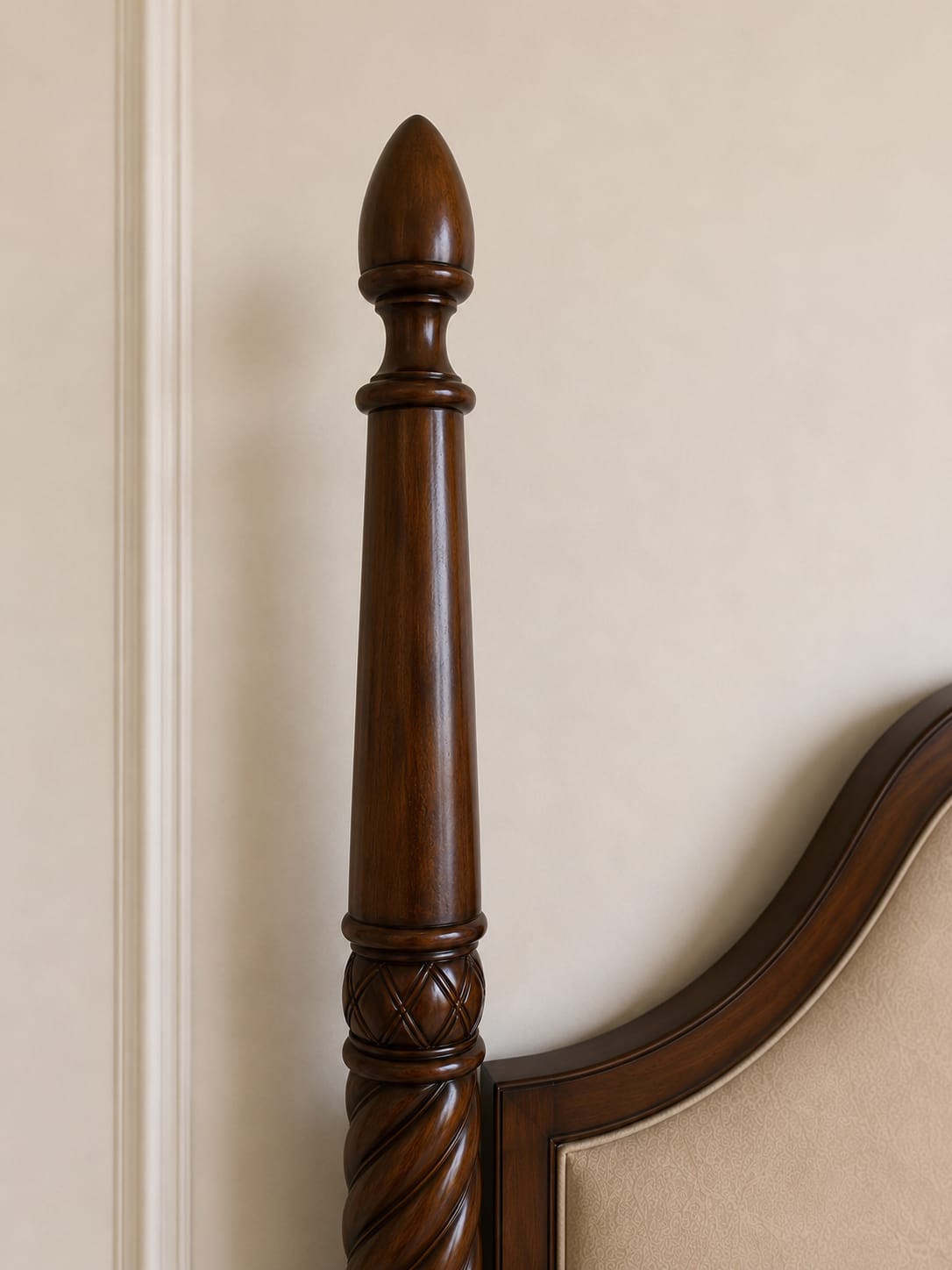
| Posts | Four tall tapered posts, barley twist carving, acorn finials |
| Finish | Deep dark wood finish (customisable) |
| Base | Solid wooden slat platform — no box spring required |
| Sizes | King, Queen, custom sizes on request |
| Price | ₹6,50,000 (MRP ₹9,50,000) |
| International reference | approx. US$6,715 / €7,386 |
| Craft time | 4–6 weeks, made to order |
| Processing time | 5–7 business days |
| Shipping | Free, tracked, secure worldwide export packing |
| Rating | 4.4 / 5 from 53 buyer reviews |
| Stock | 1 slot open at current lead time |
What exactly is a four poster bed — and why is it back?
A four poster bed is defined by four vertical columns rising from each corner of the frame. Historically those posts held a tester frame and heavy curtains that kept warmth in and draughts, insects and prying eyes out. In India, the form arrived through two separate currents: European colonial furniture makers working in Bombay, Calcutta and Delhi, and the older indigenous tradition of the carved palang, the ceremonial wooden bed that anchored a haveli's inner rooms.
What survived from both traditions is the sense of architecture inside a room. A four poster does not sit against a wall the way a low platform bed does. It draws vertical lines through the space, frames the sleeper, and gives an ordinary rectangular bedroom a centre of gravity. That is the single reason the form has returned so forcefully in contemporary interiors: after a decade of low, horizontal, Scandinavian-influenced beds, designers went looking for height again.
This particular piece is a contemporary reading of the form, not a museum copy. There is no tester, no canopy fabric, no fringe. The posts stop at their acorn finials and let the ceiling do the rest. That restraint is what makes it work in a modern apartment as easily as in a heritage bungalow.
The barley twist post: the hardest detail on this bed
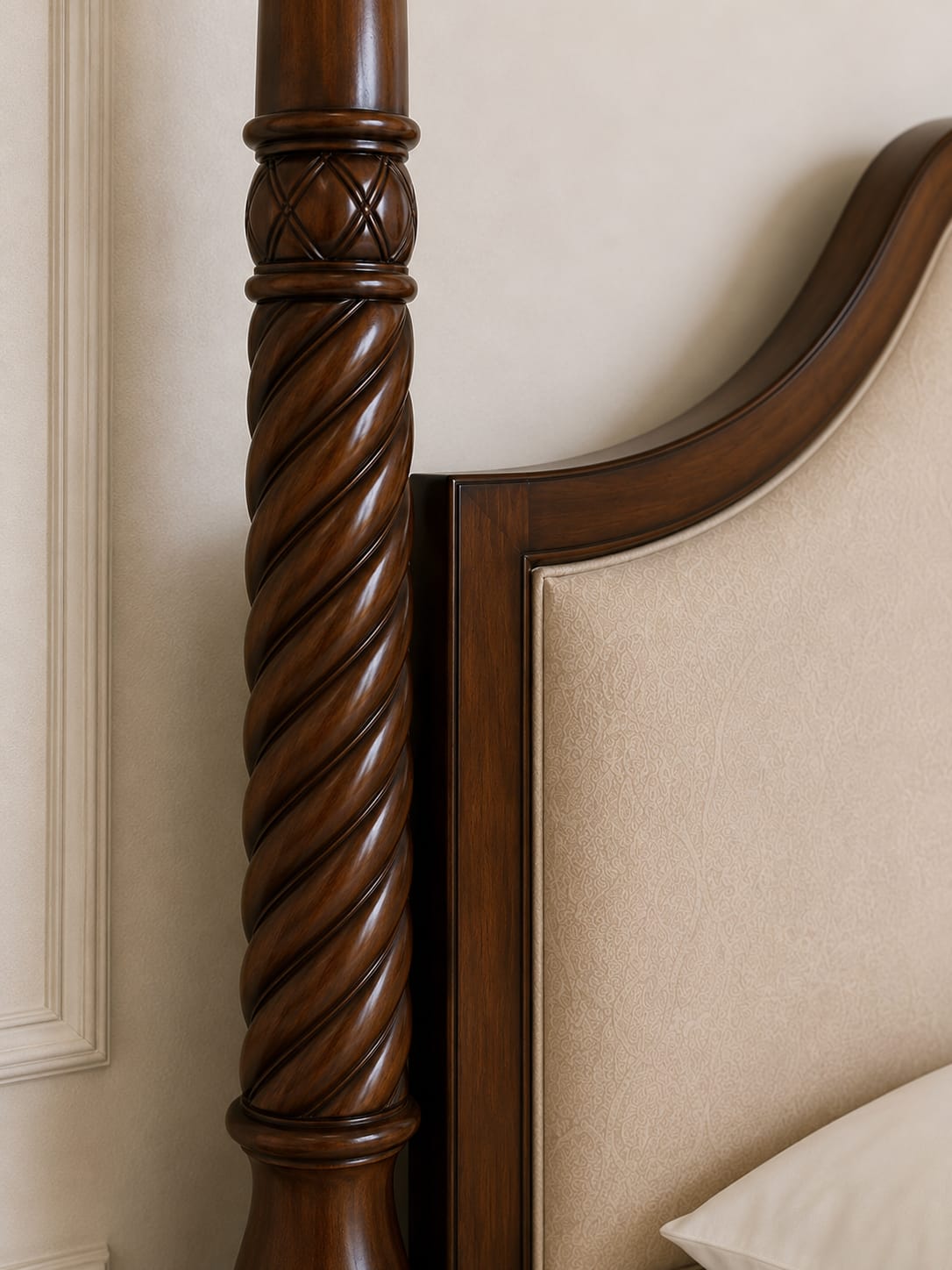
Barley twist — sometimes called spiral turning, rope twist or Solomonic turning — is a spiral cut that runs the full length of a turned column. It first appeared widely in European furniture in the seventeenth century, faded, and returned under the Victorians who used it on everything from table legs to hall stands.
It is also the single most demanding element in this bed, and it is worth understanding why before you compare prices anywhere else.
How a real barley twist is made:
- The post is first turned round and true on a lathe, from a single length of teak. Joined or laminated stock will telegraph a glue line straight down the spiral, so the blank has to be one piece.
- The turner marks a helix along the cylinder by hand, dividing the length into equal segments and stepping the line around the circumference at a constant rate. Any drift here is permanently visible.
- The groove is cut with rasps and gouges, working with the grain, then refined so that the ridge crest stays even and the valley depth stays constant end to end.
- The spiral is sanded by hand through progressive grits — machines cannot follow the helix without flattening the crest.
- Finally the four posts are compared side by side and matched so that the twist pitch reads identically across the bed.
A single post takes an experienced turner the better part of a day. Four matched posts are the bulk of the labour in this frame.
How to spot a fake: mass-market "barley twist" is usually CNC-routed into a softwood or rubberwood blank and then stained dark to hide the tear-out. Look for a spiral that is uniformly shallow, a crest that feels sharp rather than rounded, and identical grain on all four posts — real teak posts will never match perfectly, because no two boards do.
The camelback headboard, and why it matters at 11pm
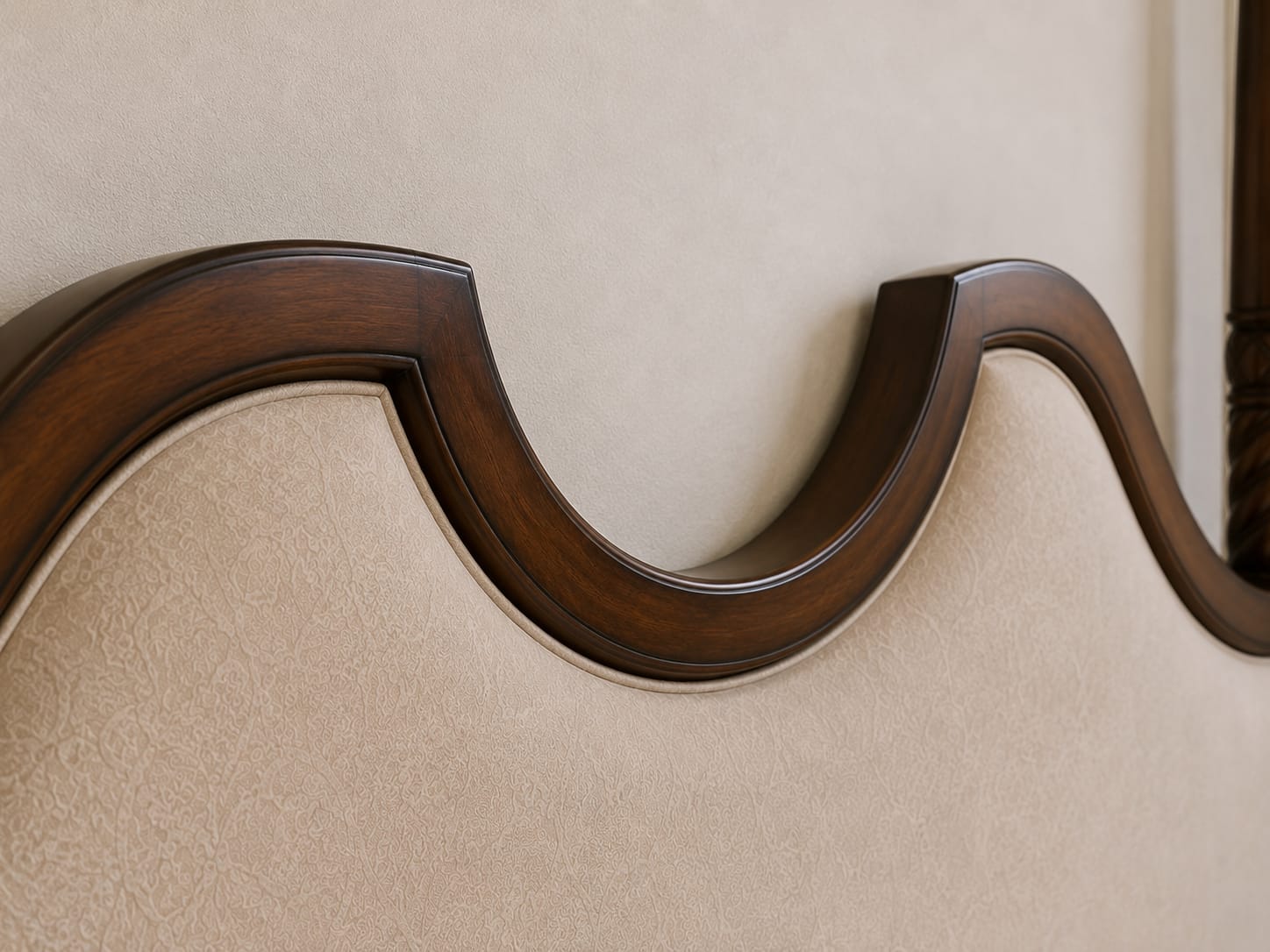
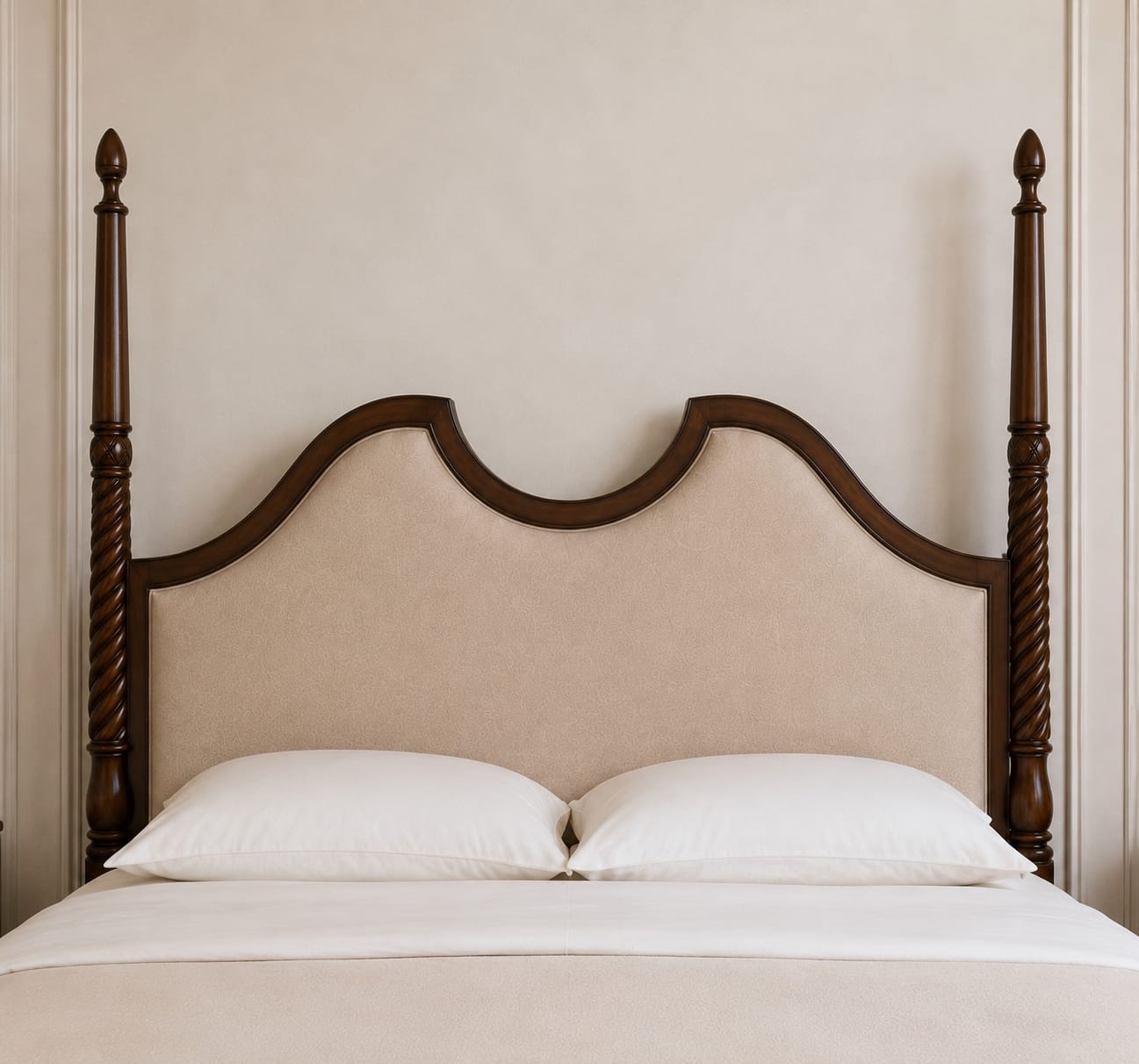
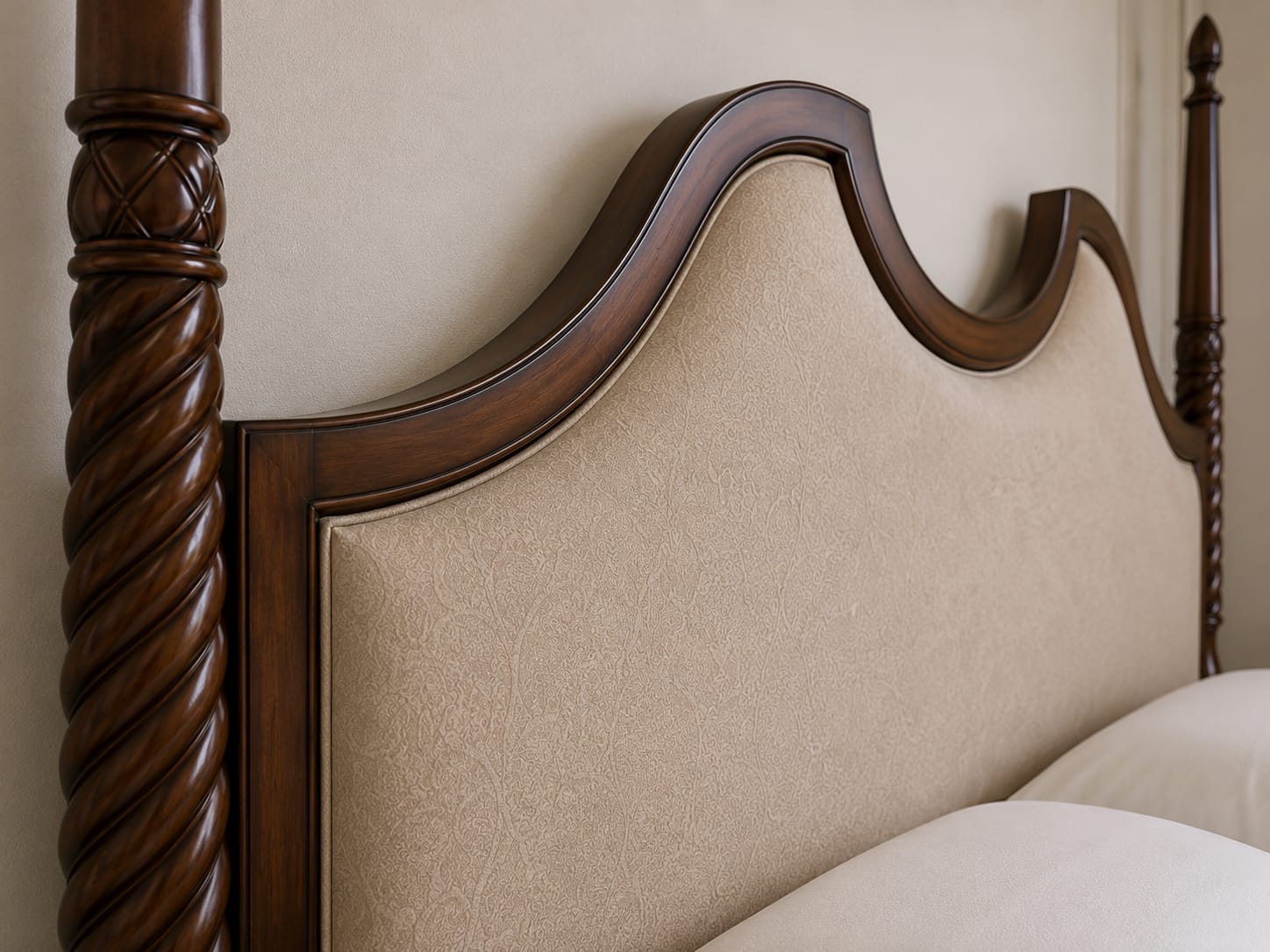
A camelback (or serpentine) headboard is one that rises to a gentle central peak and curves down to the shoulders. It was a Georgian and Chippendale sofa profile long before it migrated to beds, and it does two things at once.
Visually, the curve breaks the hard rectangle of the frame. In a bedroom full of straight lines — door frame, wardrobe, window, mattress — a single arc is what stops the room reading as a box.
Practically, the upholstery makes the bed usable for the two hours a day most people are awake in it. A carved wooden headboard looks superb and is punishing to lean against. This one is padded and fabric-wrapped across the full curve, so you can sit up and read, work on a laptop, or feed a baby at 3am without stacking four pillows behind you.
Fabric is your choice. Practical guidance from the workshop:
- Cotton velvet — the classic pairing with dark teak. Deep, light-catching, warm. Vacuum monthly with a brush head.
- Linen and linen blends — breathable, ideal for Chennai, Mumbai, Goa and other humid coastal cities. It will relax and crease; that is the material, not a defect.
- Boucle — soft, contemporary, forgiving of dust. Avoid it if you have cats.
- Performance weaves — the sane choice if children or pets share the bed. Ask for a stain-resistant finish before you approve the fabric.
- Leather or leatherette — dramatic, easy to wipe, and hot to lean against in an unairconditioned summer.
Why solid teak, specifically
Teak (Tectona grandis) is the reason Indian furniture from the nineteenth century is still standing. Three properties matter for a bed:
Natural oils. Teak contains tectoquinone and a high natural oil content, which is why it resists termites, borers and fungal decay without chemical treatment. In a country where a mango-wood or rubberwood frame can be quietly eaten from the inside in a decade, this is not a luxury detail — it is the whole argument.
Dimensional stability. Teak moves less with humidity swings than almost any other commercial hardwood. A bed frame lives through monsoon and dry season every year. Joints in an unstable timber loosen, creak and eventually rack. Teak joints stay tight.
Strength-to-weight. Teak is dense enough to carry a king mattress plus two adults plus the leverage of four tall posts, without needing clumsy oversized sections. That is what keeps the posts elegant rather than chunky.
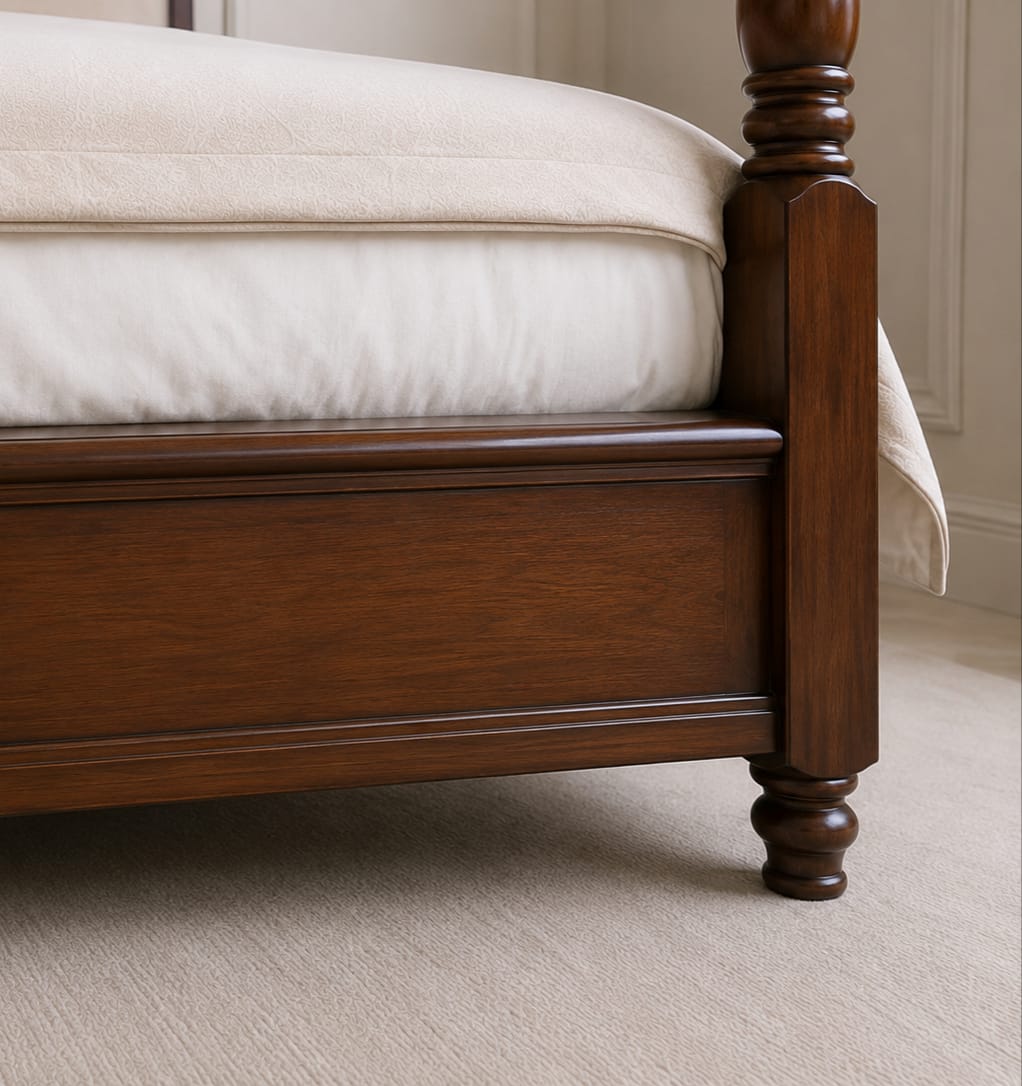
A note on honesty, because this is where most listings lie: solid teak is not the same as teak veneer, teak finish, or "teakwood" as a colour name. This bed is solid throughout the posts, rails, headboard frame and footboard. You can ask the studio for photographs of the raw components before finishing, and 1Antiq's editorial team inspects samples from each workshop before that workshop is approved to sell.
Solid teak versus the alternatives
| Material | Termite resistance | Lifespan | Typical cost | Notes |
|---|---|---|---|---|
| Solid teak | Excellent, natural | 50–100+ years | Highest | Ages to a deeper patina; repairable forever |
| Sheesham / rosewood | Good | 30–50 years | High | Heavier, darker, more open grain |
| Mango wood | Poor without treatment | 10–20 years | Medium | Soft, dents easily under posts |
| Rubberwood | Poor | 5–15 years | Low | Almost always finger-jointed |
| Engineered / MDF | None | 3–8 years | Lowest | Fails permanently once water reaches the core |
Sizing: get this right before you order anything
Because the bed is made to order, sizing is a decision, not a constraint. Which also means the responsibility is yours. Measure twice.
| Size | Mattress (India) | Mattress (US/UK reference) | Minimum room recommended |
|---|---|---|---|
| Queen | 60 x 78 in | 60 x 80 in (US Queen) | 11 x 12 ft |
| King | 72 x 78 in | 76 x 80 in (US King) | 12 x 14 ft |
| Custom | Any | Any | Specify at order |
Additional clearances that people forget:
- Post height versus ceiling. Four poster posts read best with at least 12–18 inches of air above the finials. Under a 9 ft slab, ask the workshop to shorten the posts; they will, at no design cost.
- Walking room. Leave 24–30 inches on both sides and at the foot. The posts are at the corners, and you will find them with your little toe otherwise.
- The staircase problem. The frame ships knocked down — headboard, footboard, side rails, posts, slats, hardware — precisely so it can go up an ordinary Indian stairwell or into a lift. Give the studio your access details anyway; they have shipped into fourth-floor walk-ups in Delhi and Bandra before.
- Mattress thickness. With a 6-inch mattress you will see a lot of frame; with a 10–12 inch mattress the proportions are correct. Tell the workshop your mattress height and they will set the slat platform accordingly.
How to style a four poster bed without it looking like a hotel lobby
The commonest mistake is treating a four poster as a costume. It works best when it is the only loud object in the room.
Rule one: give it emptiness. Bare walls on either side, or one restrained pair of sconces. No gallery wall behind a camelback headboard — the two curves fight.
Rule two: keep bedding quiet. White or oatmeal linen, one textural throw at the foot, two Euro shams and two sleeping pillows. Nothing patterned. The barley twist is the pattern.
Rule three: go low around it. Because the posts are vertical, everything else should be horizontal — a low bench at the foot, flat-front nightstands, a wide dresser. Tall wardrobes flanking a four poster make a bedroom feel like a corridor.
Rule four: light it from below and beside, never above. A ceiling light behind the finials creates a cage of shadows across the ceiling. Table lamps at 24–26 inches, or wall sconces at 52–58 inches from the floor, are correct.
Three directions that work with this specific bed:
- Modern colonial — dark teak, white walls, jute rug, planter, brass. The most natural fit.
- French country — soft chalky walls, a linen headboard in oatmeal, cane nightstands, antique mirror above the dresser rather than the bed.
- Warm minimal / transitional — greige walls, one large abstract canvas on the opposite wall, no other timber tones in the room besides the bed.
Optional canopy. Because the posts are structurally sound, you can add a light muslin or mosquito drape later. Ask the studio to fit discreet hooks at the post tops at the time of manufacture; retrofitting means drilling into a finished post.
What is actually included
- Headboard (upholstered camelback)
- Footboard (plain recessed panel)
- Two side rails
- Four barley twist posts with acorn finials
- Wooden slats
- Assembly hardware and instructions
Not included: mattress and bedding.
Assembly is a two-person, roughly 45-minute job with an Allen key. Tighten every bolt finger-tight first, square the frame, then torque in a diagonal pattern — the same sequence you would use on a car wheel. This is the single biggest cause of "my bed creaks" complaints on any four poster, anywhere.
Care, over decades not seasons
Solid teak asks for very little, but it does ask.
Weekly. Dry microfibre along the grain. On the posts, work the cloth into the spiral valley; that is where dust settles and where it eventually dulls the finish.
Monthly. Vacuum the upholstered headboard with a soft brush attachment, including the piping seam. Rotate your mattress while you are at it.
Twice a year. Wipe the frame with a barely damp cloth, dry immediately, and apply a thin coat of a good furniture wax or teak-safe polish. Buff off completely. Never leave polish sitting in the twist grooves — it goes gummy and traps dust.
Every two to three years. Recheck every bolt. Wood compresses very slightly at joint faces over time; a ten-minute tightening restores silence.
Never: silicone spray polish, ammonia or glass cleaner, or direct steam. Keep the frame out of direct afternoon sun, which will bleach an oiled teak finish unevenly over a few summers.
Spills on upholstery: blot, never rub. Work inward from the edge of the stain. For velvet, let it dry fully and then brush the pile back up.
Made to order: what the 4–6 weeks actually buys
This is not a warehouse item with a slow courier. The lead time is production, and it looks like this:
- Timber selection (week 1). Seasoned teak boards are chosen and matched for grain and colour so that the four posts and the visible rails read as one piece of furniture.
- Milling and joinery (week 1–2). Rails, headboard frame and footboard are cut and mortised. Post blanks are prepared.
- Turning and carving (week 2–3). The barley twist is turned and hand-finished, finials shaped, and the whole frame dry-assembled and checked square.
- Upholstery (week 3–4). The camelback is padded, fabric is cut on the correct grain, wrapped, and finished.
- Finishing (week 4–5). Multiple coats of the dark finish, cut back between coats, then final buffing.
- Inspection and export packing (week 5–6). Every component is photographed, corner-protected, foam-wrapped and crated for tracked despatch.
Add 5–7 business days of processing before that clock starts. Customisation of wood finish, fabric, colour, size and design is available — message the studio before placing the order, not after.
Because each piece is hand-built from natural timber, variation in grain, colour and figure is expected and is not a defect. It is the difference between furniture and product.
Is ₹6,50,000 justified?
Reduced from ₹9,50,000, this bed sits firmly in the heirloom bracket. It is useful to be blunt about where that money goes and who should not spend it.
What you are paying for: roughly four days of skilled turning and carving labour, seasoned solid teak in king-bed sections, hand upholstery, a multi-coat hand-applied finish, and export-grade crating. Roughly two-thirds of the cost is human hours; the rest is timber and freight.
Cost per year of use. Priced over a conservative fifty-year life, that is about ₹13,000 a year, and the frame is repairable and refinishable at the end of it. A ₹60,000 engineered-board bed replaced every seven years costs more in cash and vastly more in landfill.
Who should buy it: anyone furnishing a permanent home, a heritage property, a boutique hotel suite, or a primary bedroom they intend to keep for decades. Anyone who has already bought two disappointing beds.
Who should not: renters who move annually, anyone under a low false ceiling, anyone who needs the bed in under six weeks, and anyone who needs under-bed drawer storage — the slat platform is fixed and the four posts make a hydraulic lift-up mechanism impractical on this design.
Returns: this piece is bespoke and returns are not accepted, which is standard for made-to-order furniture. That makes the pre-order conversation the important step. Ask for fabric swatches, ask for finish samples, confirm dimensions in writing, and ask for progress photographs during weeks 3 and 5.
How it compares to the alternatives you are probably also considering
| This four poster | Modern platform bed | Metal canopy bed | Antique reclaimed four poster | |
|---|---|---|---|---|
| Presence in the room | Very high | Low | High | Very high |
| Material honesty | Solid teak throughout | Usually engineered core | Steel, powder-coated | Variable, often repaired |
| Customisable size/fabric | Yes | Rarely | No | No |
| Structural lifespan | 50–100+ years | 5–15 years | 15–25 years | Unknown |
| Repairable | Fully | No | Welding only | Specialist only |
| Lead time | 4–6 weeks | Immediate | Immediate | Whatever is in stock |
| Ceiling requirement | 9.5 ft+ ideal | None | 9 ft+ | 10 ft+ |
| Resale value | Holds well | Near zero | Low | Holds well |
Frequently asked questions
Do I need a box spring or a separate bed base? No. The frame includes a full wooden slat platform designed to carry the mattress directly. Adding a box spring would raise the mattress too high relative to the headboard curve.
What mattress works best on wooden slats? Any pocket-spring, latex or high-density foam mattress between 8 and 12 inches. Slat platforms actually extend mattress life because they let the core breathe — important in humid Indian cities.
Is it available in Queen, or only King? King and Queen are both standard, and fully custom sizes are made on request, including US King, UK Super King and non-standard lengths for taller sleepers.
Can I choose a lighter wood finish? Yes. The dark finish is the house default, but honey teak, walnut, weathered grey and distressed antique finishes are all available. Request physical samples before confirming.
Can I change the headboard fabric? Yes — colour, weave and performance treatment are all your choice. The studio will send swatches before cutting.
Will it fit through my door and up my stairs? Almost certainly, because it ships knocked down as separate posts, rails, headboard and footboard. Send your access measurements when you order and the workshop will confirm.
How long does delivery take in total? 5–7 business days of processing plus 4–6 weeks of crafting, then tracked despatch. Shipping is free, and secure worldwide export packing is available.
Does it creak? Not when assembled correctly. Tighten all bolts finger-tight, square the frame, then torque diagonally. Recheck every couple of years.
Is teak sustainable? The workshop uses plantation and legally sourced seasoned teak. Ask for sourcing documentation if it matters to you — a workshop that cannot answer that question is telling you something.
Can I add a canopy or mosquito net later? Yes, but request hooks or a tester rail at the time of manufacture rather than drilling into finished posts.
Can it be returned? No. Made-to-order pieces are non-returnable. Manufacturing defects and transit damage are handled directly by the studio.
Will my bed look exactly like the photographs? It will match in design, proportion and finish. Grain and colour will differ slightly, because it is cut from real wood for you specifically.
The verdict
Very few beds are worth writing three thousand words about. This one earns it because almost every decision in it is the harder, slower, more expensive option: solid teak instead of veneer, hand-turned barley twist instead of routed spirals, a padded camelback you can actually lean on instead of a carved panel that only photographs well, and a slat platform that respects the mattress.
Buy it if you want the bedroom finished for the next thirty years. Skip it if you need it next week.
Written by The 1Antiq Editorial Team. Technically reviewed by Areeba Parveen, Master Furniture Artisan. Every listing on 1Antiq is produced by a verified workshop, and our editors physically inspect samples from each studio before it is approved to sell.