Luxury Beige & Antique Gold Custom Bed Frame: The Complete French Bed Buyer's Guide
Hand-carved gilding, a deeply padded beige headboard and a solid teak body: how a real French bed is built, and how to spot the resin-and-spray-paint copies.
In one paragraph
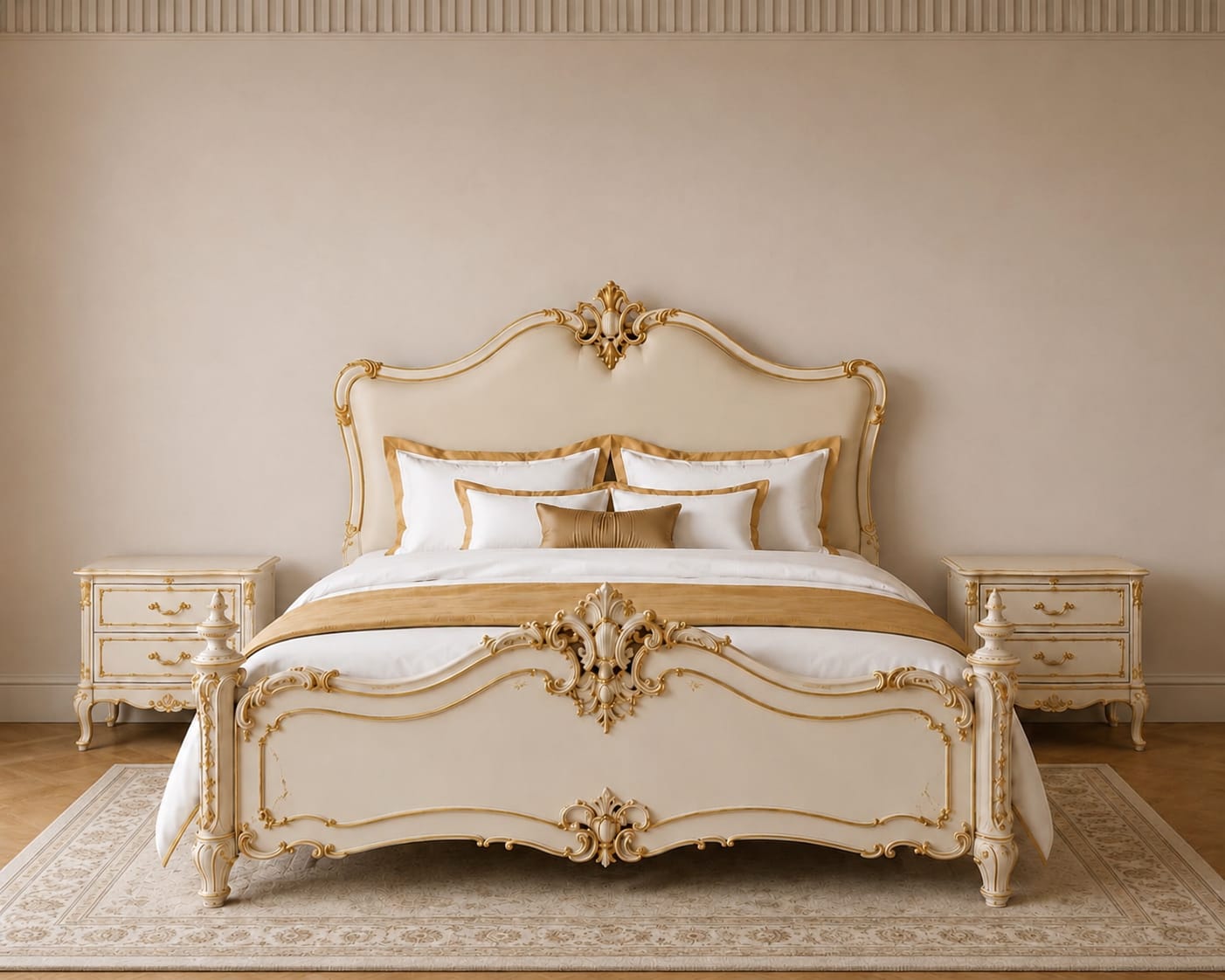
The Luxury Beige & Antique Gold Custom Bed Frame by Maison Areeba on 1Antiq is a made-to-order French-style bed with a padded beige upholstered headboard, hand-carved antique gold gilded detail and a premium solid teak frame. It costs ₹8,50,000 (from ₹10,50,000), takes 2–3 weeks to build, ships free and tracked, and comes in Twin, Full, Queen (64"W x 84"L x 60"H), King (80"W x 84"L x 60"H), California King and custom sizes with customisable fabric, finish and headboard style.
Quick answer
The Luxury Beige & Antique Gold Custom Bed Frame is a made-to-order French-style bed hand-built by Maison Areeba, a verified workshop on 1Antiq. It pairs a deeply upholstered beige headboard with hand-carved, antique gold-leafed cresting and frame detail, all built on a body of premium seasoned solid teak. It is priced at ₹8,50,000 (down from ₹10,50,000), ships free and tracked, and is available in Twin, Full, Queen, King and California King, plus fully custom sizes, fabrics, finishes and headboard silhouettes. Lead time is 2–3 weeks. Queen measures 64" W x 84" L x 60" H; King measures 80" W x 84" L x 60" H.
Best for: French, Rococo, Louis XV/XVI, Victorian, Parisian-apartment and modern-glam bedrooms — and for buyers who want gold that reads as aged and hand-applied rather than sprayed and shiny.
Key specifications at a glance
| Detail | Specification |
|---|---|
| Product | Luxury Beige & Antique Gold Custom Bed Frame, French Handmade Vintage Furniture |
| Studio | Maison Areeba (verified 1Antiq workshop) |
| Style | French / Louis XV–XVI influenced, Rococo cresting, Victorian proportions |
| Primary material | Premium seasoned solid teak wood |
| Upholstery | Beige fabric, padded headboard (tufting optional), fabric of your choice |
| Accents | Hand-carved detail finished in antique gold |
| Sizes | Twin, Full, Queen, King, California King + custom |
| Queen dimensions | 64" W x 84" L x 60" H |
| King dimensions | 80" W x 84" L x 60" H |
| Price | ₹8,50,000 (MRP ₹10,50,000) |
| International reference | approx. US$8,781 / €9,659 |
| Processing / lead time | 2–3 weeks, made to order |
| Shipping | Free, tracked, secure export packing |
| Rating | 4.7 / 5 from 118 buyer reviews |
| Returns | Not accepted (bespoke build); defects and transit damage covered |
| Stock | 1 production slot open at current lead time |
What this bed actually is, in plain language
Strip away the styling language and you have three things joined into one object:
- A structural hardwood frame — solid teak rails, headboard frame, footboard and legs, jointed and pinned to carry a mattress for decades without racking.
- An upholstered face — foam and wadding built up over a shaped headboard panel, then wrapped in beige fabric and hand-finished at the edges.
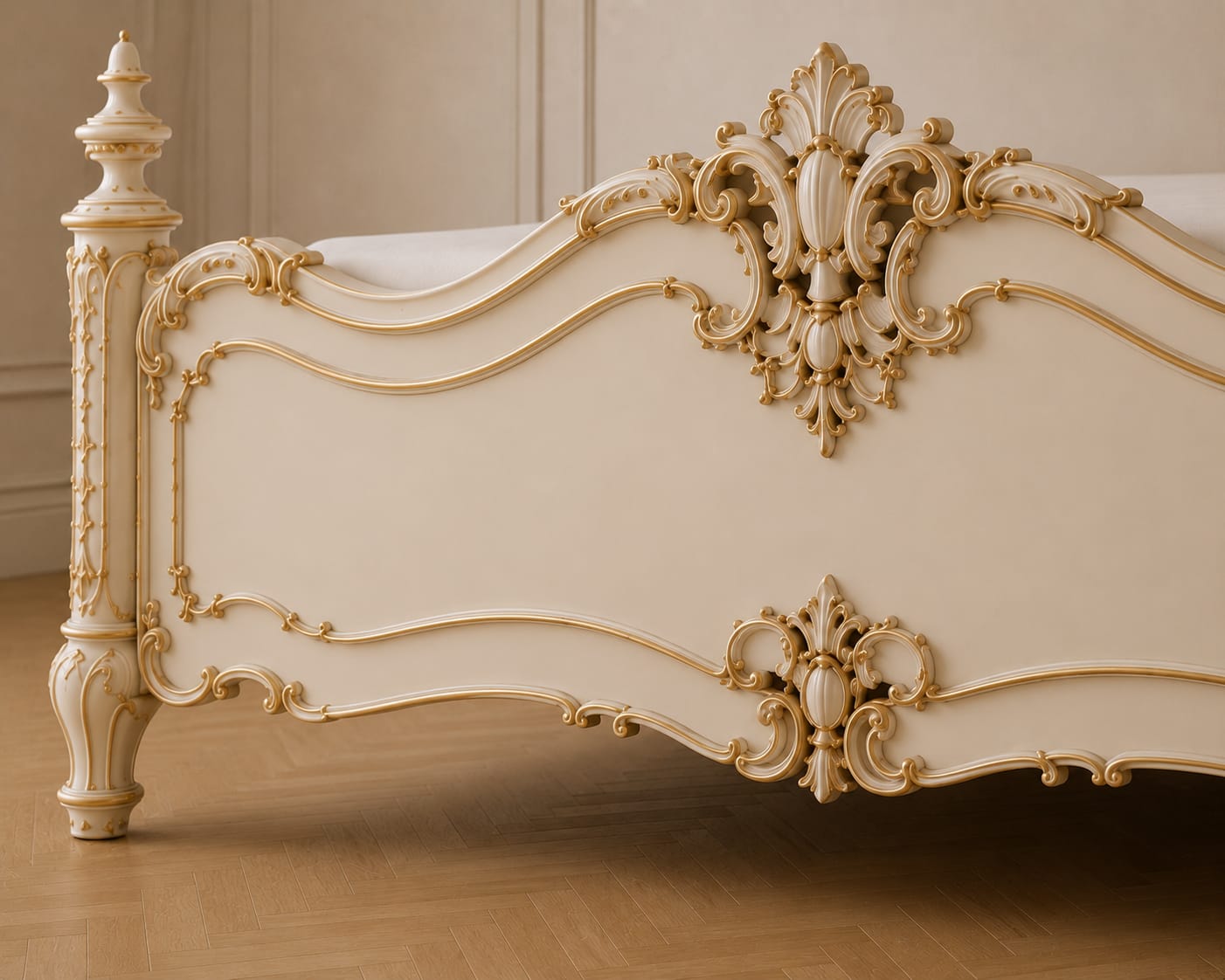
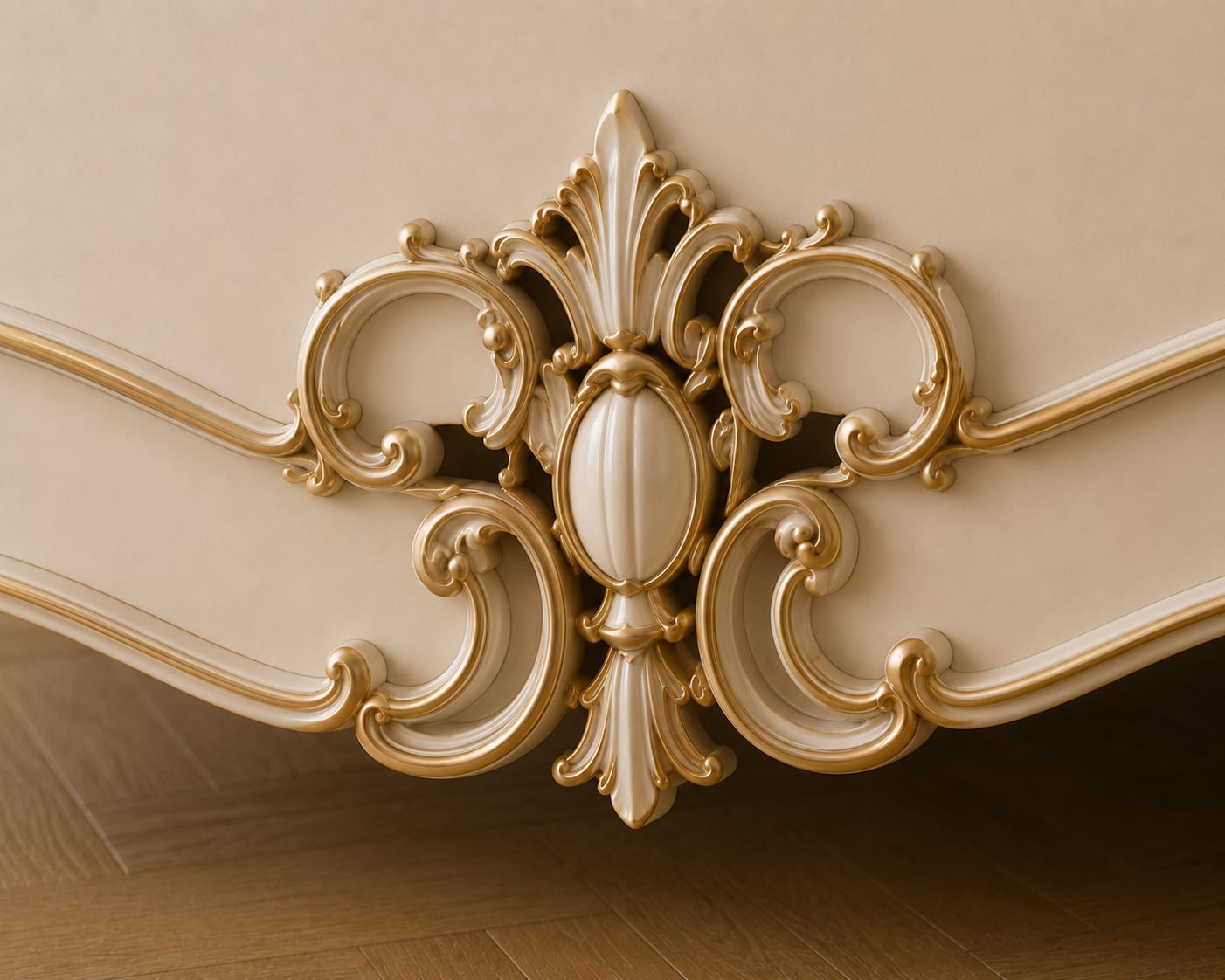
- A carved and gilded overlay — hand-carved scrollwork, shells, acanthus leaves and floral cresting, water-gilded or leaf-finished in antique gold and then toned back so it doesn't glare.
Almost every mass-market "French bed" you can buy online gets two of those three wrong. The frame is engineered board or rubberwood, the carving is resin cast in a mould and glued on, and the gold is gold-coloured spray paint. This piece is the traditional construction: real timber, real carving, real leaf, real hand-stitched upholstery.
That is the entire price difference, and it is worth understanding in detail before you compare it with anything else.
The French bed tradition, and where this one sits in it
French bed design is not one style. It is roughly two centuries of arguing about curves.
Louis XIV (Baroque, late 1600s). Heavy, symmetrical, architectural. Straight lines dressed in ornament. Beds were state furniture — enormous, curtained, designed to be seen from a distance in a room where the king received visitors.
Louis XV (Rococo, ~1730–1760). The rules break. Curves become asymmetric, cabriole legs appear, cresting rails swell into shells and C-scrolls, ornament grows out of the structure instead of sitting on it. This is the moment that gave us the classic French bed silhouette: a curved, crested headboard, a matching lower footboard, and carved legs.
Louis XVI (Neoclassical, ~1760–1790). The reaction. Straight fluted legs, laurel wreaths, ribbons, oval medallions. Calmer, more restrained, more symmetrical.
Second Empire and Victorian (1800s). Deeper buttoning, heavier padding, more upholstery, darker fabrics, and the invention of the properly comfortable headboard as a place to sit and read.
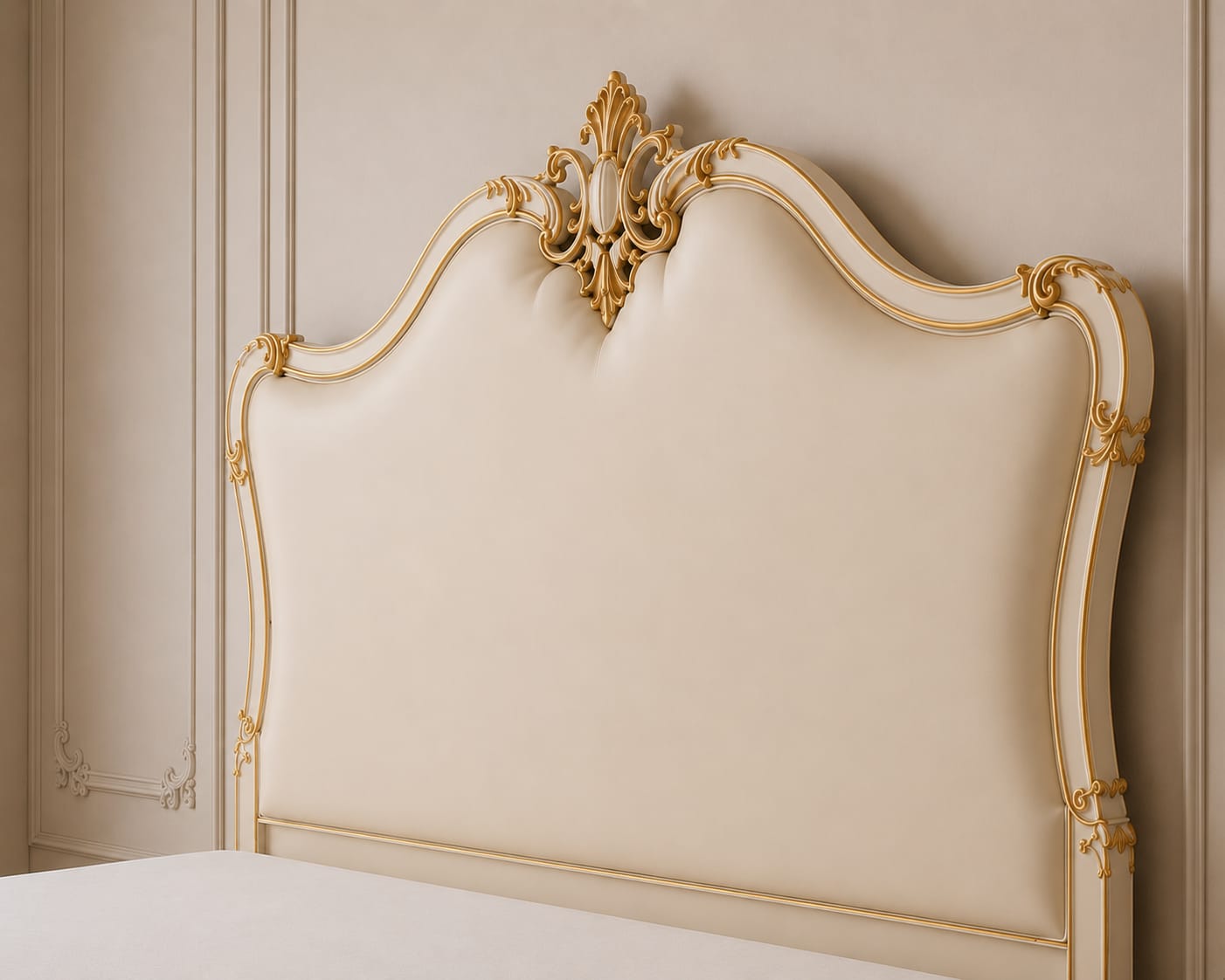
This bed is a Rococo-influenced Louis XV silhouette with Victorian upholstery depth. The cresting curves and the carving flows, but the padded, buttoned face and the generous 60-inch headboard height come from the later tradition. That combination is deliberate: the earlier styles look better in photographs; the later one is what you actually want to lean against.
Which French style are you actually asking for?
| If you want | Ask the studio for | Reads as |
|---|---|---|
| Softer, romantic, curved | Louis XV cresting, cabriole legs, shell motif | Rococo, Parisian, feminine |
| Cleaner, more formal | Louis XVI, fluted straight legs, wreath medallion | Neoclassical, restrained, unisex |
| Deeper, heavier, plusher | Deep diamond tufting, taller headboard, thicker roll edge | Victorian, hotel-suite, dramatic |
| Modern glam | Minimal carving, gold on the frame edge only, flat panel | Contemporary, gallery-like |
All four are buildable on this frame. Say which one you mean at the enquiry stage, not after the carving has started.
Antique gold versus bright gold: the detail that decides whether this looks expensive
This is the single most important paragraph in this guide.
Bright, uniform, high-shine gold is what cheap furniture uses, because spray paint is uniform by nature. Real gilding is never uniform. It has variation in the leaf, breaks along the high points where the burnisher passed, and a darker tone settled into the recesses of the carving. That contrast — light crests, dark valleys — is what makes carved ornament legible from across a room. Uniform gold flattens carving into a blob.
How Maison Areeba finishes the gold on this bed:
- Carving is completed and sanded — the profile has to be finished before any finish goes on; you cannot sand a gilded surface.
- Gesso and bole. Layers of gesso build a glass-smooth ground. A coloured clay bole — traditionally red or ochre — goes over it. That bole colour is what glows through the leaf and gives real gilding its warmth.
- Leaf laid by hand. Sheets are laid down and pressed into the carving with a soft brush. Overlaps and joins are intentional and visible under raking light.
- Burnishing. High points are polished with an agate burnisher so crests catch light while recesses stay matte.
- Antiquing. A tinted glaze is brushed on and wiped back, staying in the recesses. This is the step that turns "new gold" into "old gold".
- Sealing. A conservation-grade sealer protects the leaf without adding plastic shine.
Ask for these three things when you order: a photograph of the gilding under angled light, confirmation of leaf type (genuine leaf, composition/Dutch metal, or gold-toned wax), and a sample chip of the antiquing depth you want. "Antique gold" is a range, not a colour code — some buyers want a whisper, some want almost-bronze.
Why beige is the correct fabric choice here (and when it isn't)
Beige is doing unglamorous, essential work on this bed.
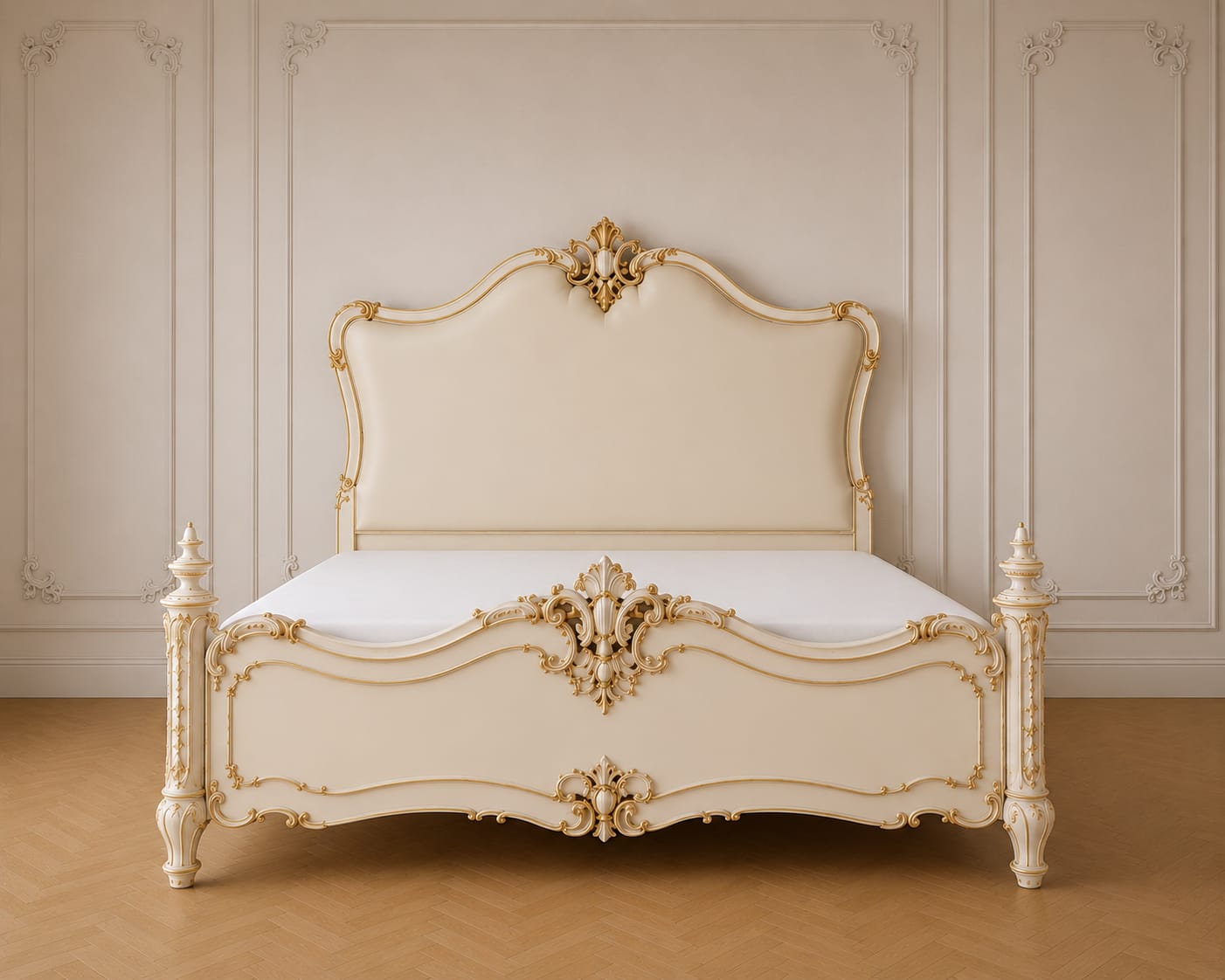
It lets the gold speak. Gilding needs a quiet neighbour. Against white the gold looks yellow; against black it looks theatrical; against beige it reads as warm metal. Beige and gold share an undertone, so the eye reads them as one family rather than two competing statements.
It photographs and lives well. A pure white headboard shows every hair oil mark and every shadow. Beige has enough pigment to hide daily contact and enough lightness to keep a large object from feeling heavy.
It survives redecoration. You will repaint the walls. You will change bedding four times. A beige headboard is still correct after all of it.
When beige is the wrong call: if your walls are already warm cream or beige, the bed disappears. In that case ask for one step of contrast — a greige, a soft taupe, a pale olive-linen, or a champagne velvet. If your room is very dark and dramatic, an ivory or oyster silk-look weave will hold its own better.
Fabric options and honest trade-offs
- Cotton velvet (beige/champagne) — the default recommendation. Depth, light response, ages well. Vacuum monthly with a brush head.
- Linen and linen blends — breathable and correct for humid coastal cities like Mumbai, Chennai, Kochi and Goa. It will relax and crease; that is the fibre, not a defect.
- Chenille — soft, hard-wearing, forgiving of dust. A good compromise for family bedrooms.
- Boucle — very current, very tactile. Avoid it if you own cats.
- Performance weave — the sensible option with children or pets. Request a stain-resistant finish before approving.
- Silk or silk-look — the most authentic to period French beds and the least practical. Beautiful in a guest suite, punishing in a daily bedroom.
Always request physical swatches. Fabric colour on a screen is a suggestion, not information.
Tufting: buttoned, channelled or plain?
The headboard can be finished three ways, and the choice changes the whole personality of the bed.
Diamond (Chesterfield) tufting. Buttons pulled deep into the padding, creating diamond folds. Maximum period drama, maximum light-and-shadow, maximum dust collection. Best in cooler, drier climates and formal rooms.
Channel tufting. Vertical padded columns, no buttons. Cleaner, more contemporary, much easier to wipe down. Reads modern-glam rather than antique.
Plain padded with a piped or roll edge. The quietest option. Lets the carving carry all the ornament. This is what most interior designers specify when the room already has a lot going on.
If you plan to sit up in bed frequently, plain or channel is more comfortable — deep buttons are felt through a thin pillow.
Sizing: read this before you order
Because the bed is made to order, sizing is a decision, not a constraint — which means the responsibility is yours. Measure twice, then measure the doorway.
| Size | Frame width | Frame length | Height | Minimum room recommended |
|---|---|---|---|---|
| Twin | approx. 44" | 84" | 60" | 8 x 10 ft |
| Full | approx. 58" | 84" | 60" | 10 x 11 ft |
| Queen | 64" | 84" | 60" | 11 x 12 ft |
| King | 80" | 84" | 60" | 12 x 14 ft |
| California King | approx. 76" | 88" | 60" | 12 x 15 ft |
| Custom | any | any | any | specify at order |
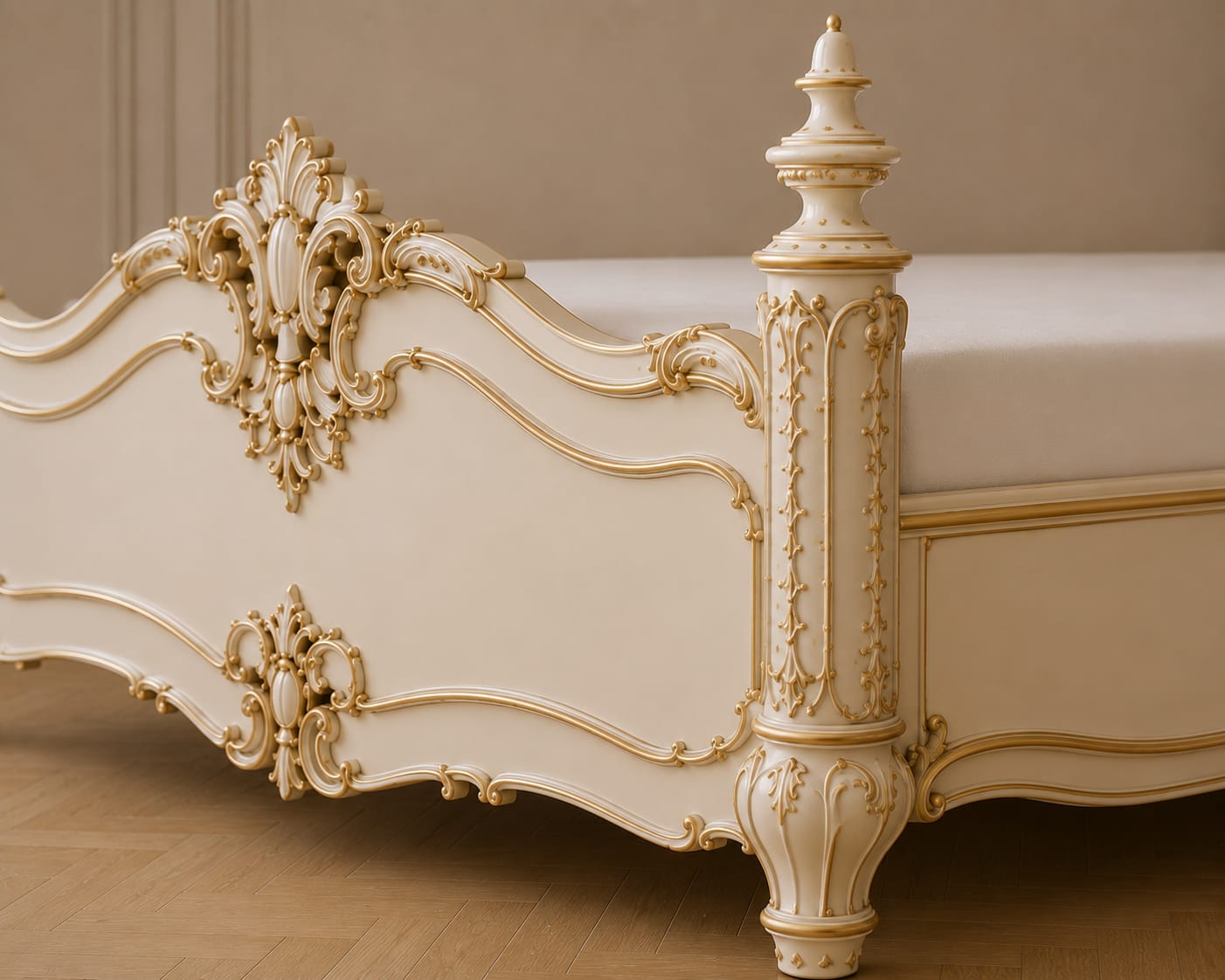
Note the difference between frame size and mattress size. A 64" wide Queen frame carries a 60" wide mattress; the extra four inches are the rails and upholstery. People order by mattress size and are then surprised by the footprint. Always plan around the frame numbers above.
Clearances people forget:
- 60 inches of headboard height is taller than most beds. Check that it clears a window sill, an AC unit, a wall-mounted light or a picture rail behind the bed.
- Leave at least 24–30 inches of walking space on each side you use.
- Leave 36 inches in front of a wardrobe with hinged doors.
- Measure the diagonal of your lift and the tightest turn on your staircase. The bed ships knocked down, but the headboard is a single large panel and it does not fold.
- If your ceiling is under 9 feet, a 60-inch headboard is still fine — but skip a canopy or tall cresting upgrade.
Solid teak under a French bed: why it matters
French antique beds were traditionally beech, walnut or limewood. Maison Areeba builds in seasoned solid teak instead, and for an Indian climate that is an upgrade, not a substitution.
Natural oils. Teak's tectoquinone content resists termites, borers and fungal decay without chemical treatment. Beech, by contrast, is a favourite food of furniture beetle. In a country where an untreated softwood frame can be hollowed out quietly in a decade, this is the whole argument.
Dimensional stability. Teak moves less with humidity swings than nearly any other commercial hardwood. This matters twice over on an upholstered bed: a moving frame loosens joints and wrinkles the fabric stretched across it.
Carving quality. Teak holds a crisp arris. Softer timbers crumble at the fine points of acanthus leaves and shell motifs, which is why cheap carving always looks slightly melted.
Repairability. Solid timber can be re-jointed, re-carved, re-gilded and re-upholstered indefinitely. Engineered board cannot be repaired at all — once the core swells, the piece is finished.
Material comparison
| Material | Termite resistance | Lifespan | Holds fine carving | Notes |
|---|---|---|---|---|
| Solid teak | Excellent, natural | 50–100+ years | Excellent | Stable through monsoon; repairable forever |
| Beech (traditional French) | Poor | 30–60 years | Excellent | Authentic but vulnerable in humid climates |
| Sheesham / rosewood | Good | 30–50 years | Good | Heavier, darker, more open grain |
| Mango wood | Poor untreated | 10–20 years | Fair | Soft; dents under leg load |
| Rubberwood | Poor | 5–15 years | Poor | Almost always finger-jointed |
| MDF / engineered | None | 3–8 years | None (resin appliqué) | Fails permanently once water reaches the core |
How to tell this apart from a mass-market copy
Six checks, in order of usefulness:
- Look for a mould seam on the ornament. Cast resin appliqué has a faint parting line and identical repeats. Hand carving is never identical twice — compare the left and right cresting.
- Look at the back of the headboard. A real workshop finishes the reverse: a fabric dust cover, clean staples, and a solid timber frame. Copies leave raw board.
- Ask what the legs are made of. On copies, the visible carved leg is often the only real timber on the whole piece.
- Ask for raw, unfinished build photographs. Any genuine workshop can supply them. Photographs of the frame before gilding tell you everything.
- Ask whether the gold is leaf, composition metal or paint. All three are legitimate at different prices — but you should know which you are buying.
- Check the weight class. A solid teak King frame is heavy. If a listing quotes a light shipping weight, it is not solid hardwood.
1Antiq's editorial team inspects samples from each workshop before that workshop is approved to sell, and Maison Areeba's carving and gilding samples were reviewed in person.
Styling the bed: four rooms that work
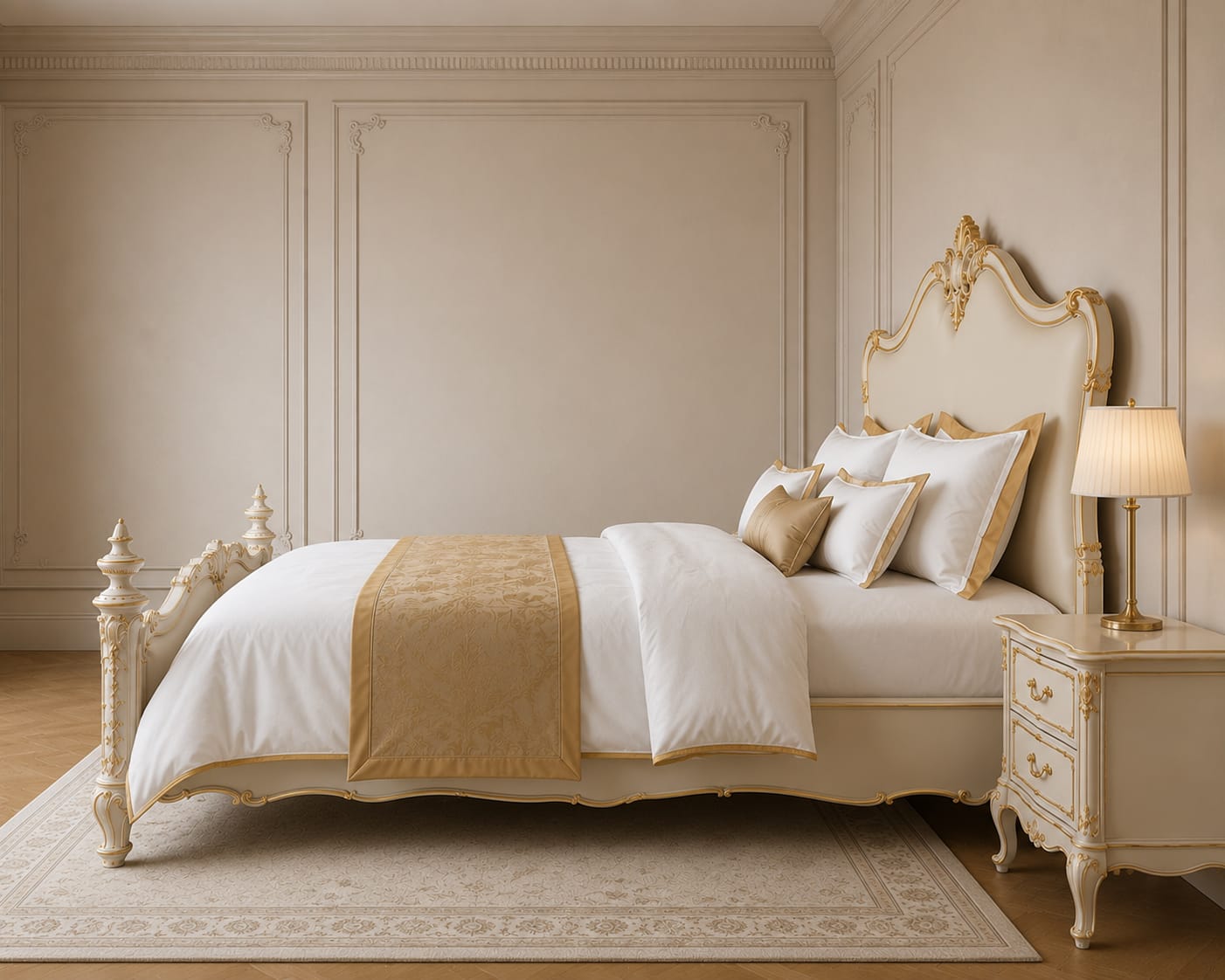
1. Parisian apartment. Off-white or pale grey walls, herringbone or light oak floor, one large gilt-framed mirror leaning opposite the bed, crisp white linen bedding with a single ochre or sage throw. Two small marble-topped side tables — not matching, deliberately. Keep the floor visible; French rooms breathe.
2. Warm maximalist. Deep olive, oxblood or ink-blue walls. The beige headboard becomes a light source against the dark field and the gold jumps forward. Layer patterned cushions, a Persian or dhurrie rug, and brass table lamps. This is the highest-impact option and the hardest to get wrong, because the bed provides the discipline.
3. Modern glam. Plaster-pink or greige walls, channel-tufted headboard, minimal carving, gold restricted to the frame edge. Pair with a smoked-glass and brass nightstand and a single oversized pendant offset to one side. Reads as contemporary luxury hotel rather than antique.
4. Indian heritage fusion. The French silhouette sits surprisingly well with Indian craft. Pair with a jaali screen, a block-printed quilt, brass diya wall sconces and a jute rug. The shared logic is hand-work; the styles agree more than they argue.
Three rules for all four:
- Do not put more gold in the room than is on the bed. One gold object leads; everything else supports. Two competing gold objects cancel each other out.
- Light the carving from the side. Wall sconces at roughly 5 ft on either side, or table lamps with the shade bottom near headboard mid-height. Overhead-only lighting flattens gilding completely.
- Keep bedding quiet. The bed is the pattern. White, oatmeal, sand and stone are the safest bedding palette; save colour for one throw and two cushions.
Care and maintenance
Weekly. Vacuum the upholstery with a soft brush head, working into the tufting and the seams. Dust the carved gold with a soft, dry, natural-bristle brush — a clean makeup brush is ideal. Never use a microfibre cloth on gilding; the fibres catch on leaf overlaps and can lift them.
Monthly. Check and gently hand-tighten the bolts at the four rail-to-post joints. Every knocked-down bed loosens slightly in the first year as timber settles. Rotate the mattress.
Every six months. Wipe exposed teak with a barely damp cloth, dry immediately, and apply a small amount of quality furniture wax or teak oil to unfinished timber areas only — never over the gilding. Inspect the leaf for lifting at high-contact corners.
Never. No all-purpose spray cleaners, no alcohol, no ammonia, no silicone polish, no steam cleaner. Alcohol dissolves the sealer over gilding, and silicone contaminates the surface so it can never be refinished properly.
Spills. Blot, never rub. Work from the outside of the mark inward. For velvet, let it dry fully then brush the pile back with a soft brush. For anything oil-based, stop and call a professional upholstery cleaner before you set the stain permanently.
Sunlight. Direct sun is the main enemy. It fades beige fabric unevenly and can dull antiquing glaze. Sheer curtains on a south or west window will add years to both.
Humidity. Aim for 40–60% RH. In extremely dry, air-conditioned rooms, gesso under gilding can crack over years; a small humidifier prevents it.
Price, value and total cost of ownership
At ₹8,50,000 against an MRP of ₹10,50,000, this is a serious purchase. Here is the honest breakdown of where the money goes:
- Carving. Hand-carved cresting, scrollwork and legs are the largest labour line. This is skilled work measured in days, not hours.
- Gilding. Gesso, bole, leaf, burnishing, antiquing and sealing is a multi-day, multi-stage process with a high material cost and no room for error.
- Upholstery. Shaping, padding, hand-stitched edges and tufting on a curved 60-inch panel is specialist work — flat rectangles are easy, curves are not.
- Timber. Seasoned solid teak in furniture-grade sections is among the most expensive commercial hardwoods available.
- Free tracked shipping with export-grade crating. A crated King frame is bulky, heavy and expensive to move safely.
Cost per year of use. A ₹8,50,000 bed used for 50 years costs ₹17,000 a year. A ₹90,000 engineered-board bed replaced every six years costs ₹15,000 a year — and you buy, assemble and dispose of eight of them, none of which can be repaired, re-upholstered or handed down. Hand-made hardwood furniture also holds resale value; particleboard has none.
Where the value genuinely is: the carving, the gilding and the teak. Where it is not: if you want the look and not the longevity, a plain upholstered bed with a gold-leafed mirror above it gets you 70% of the effect for a fraction of the price. That is a legitimate choice and worth saying out loud.
Ordering, lead time and delivery
Step 1 — Enquire and specify. Send your size, fabric direction, tufting style, gold intensity and any carving preferences. Ask for swatches and gilding samples now, not later.
Step 2 — Approve. The workshop confirms drawings and final dimensions. Check the numbers against your room and your access route before approving. After approval the build starts and changes are no longer possible.
Step 3 — Build. Lead time is 2–3 weeks. Ask for progress photographs at the raw-frame stage and again after gilding.
Step 4 — Crating and shipping. Free, tracked, secure export packing. The bed ships knocked down: headboard, footboard, two side rails, legs and slat set.
Step 5 — Assembly. Two people, roughly 45–60 minutes. Assemble in the room where it will live — the assembled frame will not pass through a standard door.
Step 6 — Inspect on arrival. Photograph the crate before opening it. Check the gilding and fabric under good light within 48 hours and report any transit damage immediately with photographs.
Returns. Because every unit is bespoke, returns are not accepted. Manufacturing defects and transit damage are handled directly by the studio.
Who this bed is right for — and who should skip it
Buy it if:
- You want a genuine hand-carved, hand-gilded French bed rather than a resin-and-spray-paint interpretation.
- You are furnishing a primary bedroom you intend to keep for a decade or more.
- You value repairability and want a piece that can be re-upholstered and re-gilded rather than replaced.
- Your ceiling and room can carry a 60-inch headboard without feeling crowded.
Skip it if:
- You move house frequently — this is a piece that should be moved rarely and carefully.
- Your interior is strictly minimalist, Japandi or industrial; the ornament will fight the room.
- You need it in under two weeks.
- You want the option to return it after seeing it in the room. Bespoke means committed.
Frequently asked questions
Is the gold real gold leaf? The finish is a traditional multi-stage gilding process with antiquing. Confirm the exact leaf type — genuine gold leaf, composition (Dutch metal) leaf, or gold-toned finish — with the studio at enquiry, as it is specified per order.
Can I choose a different fabric colour instead of beige? Yes. Fabric, colour, finish, size and headboard style are all customisable. Request physical swatches before confirming; screen colour is unreliable.
What sizes are available? Twin, Full, Queen, King and California King as standard, plus fully custom sizes. Queen is 64" W x 84" L x 60" H and King is 80" W x 84" L x 60" H.
Does it need a box spring? No. The frame is supplied with a slat support system that carries the mattress directly. Confirm your mattress thickness at order so the rail height is set correctly.
How long does it take to make? Processing and crafting take 2–3 weeks, after which the bed ships free with tracked, secure export packing.
Will it fit through my door and up my staircase? The bed ships knocked down, but the headboard is one large panel roughly 60 inches tall and as wide as the frame. Measure your narrowest doorway, lift and stair turn and share the numbers before ordering.
Is the frame really solid wood? Yes — premium seasoned solid teak throughout the structural frame, rails, legs and headboard frame. Ask for raw build photographs before finishing if you want to verify.
Can the carving be made simpler or more elaborate? Yes. Carving density, cresting height and motif are all adjustable. Simpler carving reduces both cost and lead time.
Can I have the gold in silver, bronze or champagne instead? Yes, the same gilding and antiquing process is used with different leaf. Champagne and antique silver both work well with beige.
How do I clean the upholstery? Vacuum weekly with a soft brush head and blot spills immediately without rubbing. Avoid all-purpose sprays, alcohol and steam.
Can it be returned? No. Bespoke pieces are non-returnable, though manufacturing defects and transit damage are handled directly by the studio.
Does the price include delivery? Yes. Shipping is free and tracked, with secure export-grade packing.
The short version
The Luxury Beige & Antique Gold Custom Bed Frame is what a French bed looks like when it is actually built the old way: solid teak underneath, hand-carved ornament, real gilding toned back to look aged, and a padded beige headboard tall enough to be genuinely comfortable. It costs ₹8,50,000, takes 2–3 weeks, comes in five standard sizes plus custom, and ships free.
It is not the cheapest way to get a French-looking bedroom. It is the only way to get one that your grandchildren can re-upholster instead of throw away.