Hand Carved Teak Wood French Provincial Mirror – Ornate Floral Victorian Wall Mirror
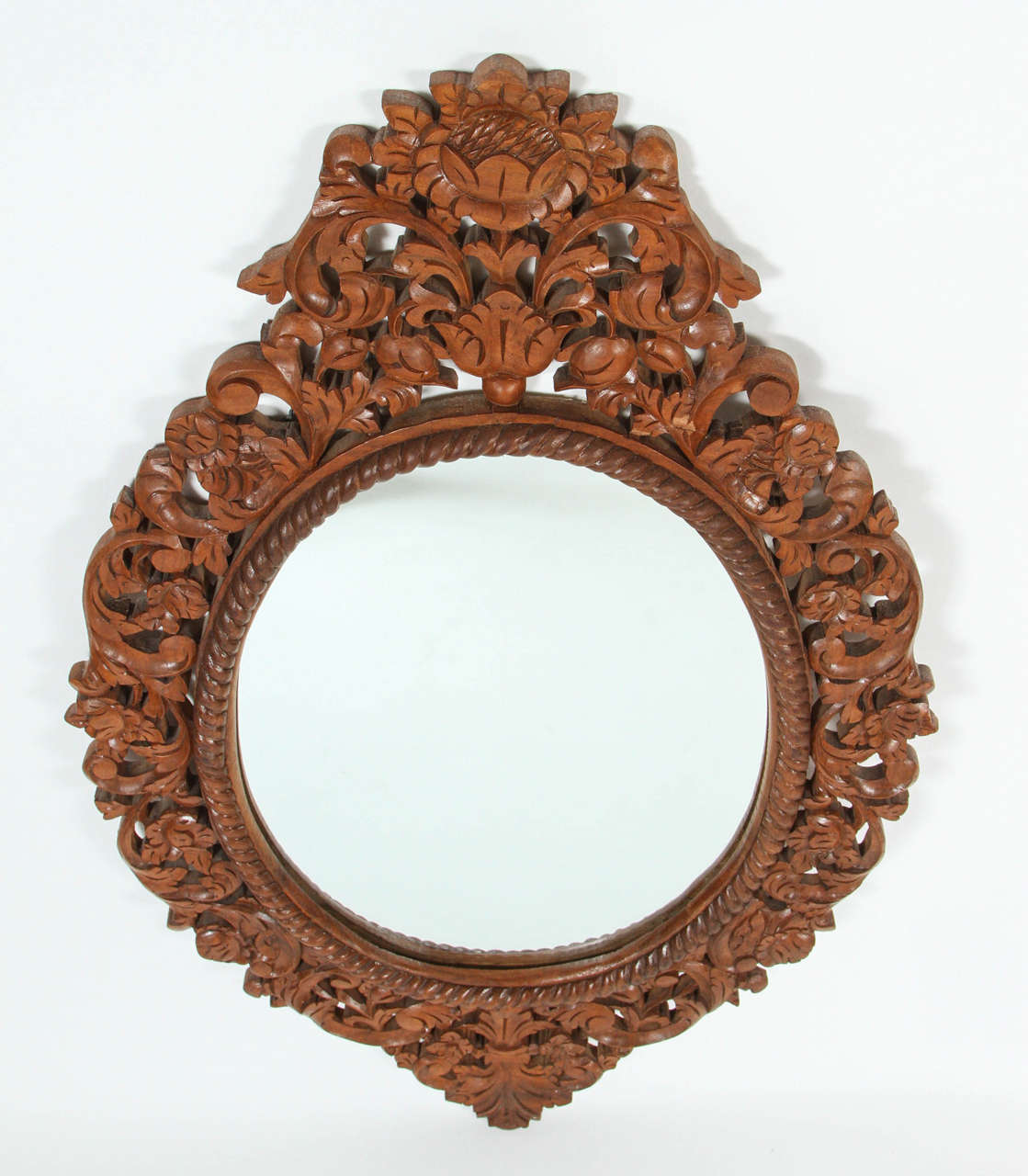
The Hand Carved Teak Wood French Provincial Mirror is an ornate round wall mirror featuring an elaborately carved floral frame inspired by French Rococo and Victorian decorative styles. Crafted as a statement piece for elegant interiors, its sculptural floral details, classic silhouette, and distressed light finish make it suitable for living rooms, entryways, bedrooms, hallways, and other sophisticated spaces.
In one paragraph
The Hand Carved Teak Wood French Provincial Mirror is a decorative statement mirror designed around traditional European-inspired craftsmanship and ornate floral detailing. The round frame features sculpted roses, leaves, scrollwork, bead-like border detailing, and a decorative crest, creating a romantic French Provincial and Victorian-inspired appearance. Product photography shows the mirror styled in elegant interiors as well as close-up views of its carved frame and unfinished woodwork, making it suitable for French Country, Rococo-inspired, vintage, traditional, romantic, and luxury home decor. The current 1Antiq listing identifies Maison Areeba in New Delhi as the maker and displays free shipping with a stated ready-to-ship time of 3 to 5 business days.
Hand Carved Teak Wood French Provincial Mirror: Ornate Floral Victorian Wall Decor for Elegant Interiors
A mirror can make a room appear larger, but some mirrors do something much more interesting. They give the room a personality.
A hand carved teak wood French Provincial mirror belongs to that second category. It is not simply a reflective surface attached to a wall. When the frame is deeply carved with floral details, scrolling forms, and decorative motifs, the mirror becomes part furniture, part ornament, and part architectural feature.
That distinction matters in interiors.
A plain mirror can disappear into a room. An ornate wooden mirror often does the opposite. It attracts attention before anyone even looks into it. The frame establishes a visual language, and everything around it begins to respond.
The Hand Carved Teak Wood French Provincial Mirror, Ornate Floral Victorian Wall Mirror is particularly interesting because several design traditions overlap in its description. There is the warmth and durability associated with teak wood, the graceful decorative vocabulary associated with French Provincial furniture, the floral ornament associated with Victorian interiors, and the increasingly popular preference for handcrafted statement pieces.
The result is a type of wall decor that can work in several very different environments.
It can anchor a traditional entryway.
It can add character to a bedroom.
It can transform a dressing area.
It can bring historical texture into a contemporary apartment.
It can also become the decorative centerpiece of a boutique hotel, heritage-inspired property, restaurant, studio, or luxury retail space.
The important question is not whether an ornate mirror is beautiful in isolation.
The better question is: how does a highly decorative mirror change the room around it?
That is where the real design story begins.
Why Hand Carved Wooden Mirrors Are Having a Moment
Interior design has spent years moving between extremes.
Minimalism encouraged clean lines, empty surfaces, neutral palettes, and furniture without excessive ornament.
Then came a renewed interest in vintage furniture, traditional craftsmanship, antique-inspired rooms, maximalism, European interiors, cottage-inspired spaces, and collected homes.
The shift does not necessarily mean that people are abandoning contemporary design.
Instead, many interiors are becoming more layered.
A modern sofa may sit beside an antique cabinet.
A contemporary kitchen may have a vintage pendant light.
A minimalist bathroom may contain a carved wooden mirror.
A clean white bedroom may feature an elaborate French-inspired headboard.
This mixing of periods is one reason ornate mirrors remain relevant.
A carved teak mirror does not require an entire room to look historical.
In fact, it can be more effective when it is surrounded by simpler objects.
The contrast gives the carving room to breathe.
A statement mirror does not need to match everything in the room. Sometimes its job is to give the room something distinctive to respond to.
That idea is particularly useful when decorating with French Provincial or Victorian-inspired furniture.
What Makes a French Provincial Mirror Different?
The phrase French Provincial is often used broadly in modern interiors.
Historically, French Provincial furniture refers to furniture associated with the provinces of France, where regional craftsmanship developed alongside and in response to more formal French court styles.
Provincial furniture could be decorative without being excessively formal.
It often emphasized:
- Curved profiles
- Carved ornament
- Floral motifs
- Natural materials
- Graceful proportions
- Painted or natural wood
- Decorative framing
- Traditional craftsmanship
A French Provincial mirror takes these principles and applies them to wall decor.
The mirror itself may be relatively simple.
The frame does the storytelling.
This is why the frame is so important.
A heavily carved wooden frame changes the visual identity of the object. The mirror becomes less like a utility item and more like a piece of decorative furniture.
The Role of Teak Wood in Decorative Mirrors
Teak is one of the most recognizable hardwoods used in furniture and architectural woodworking.
Its natural oils, dimensional stability, durability, and distinctive grain have made it valuable across different furniture-making traditions.
For a decorative mirror, however, teak offers something beyond structural performance.
It provides visual warmth.
A wooden frame introduces a natural surface around what would otherwise be a highly reflective, potentially cold material.
Glass reflects.
Wood grounds.
That contrast can make a mirror feel more substantial.
Why Wood Changes the Character of a Mirror
Compare two mirrors:
One has a thin metal frame.
The other has a deeply carved wooden frame.
Even if the glass dimensions are identical, the two objects communicate completely different ideas.
The metal-framed mirror may feel:
- Contemporary
- Industrial
- Minimal
- Light
- Architectural
The carved wooden mirror may feel:
- Traditional
- Warm
- Decorative
- Historical
- Handcrafted
- Luxurious
Neither language is inherently better.
They simply create different atmospheres.
For people looking for vintage wall decor, French Provincial interiors, Victorian decorating, or traditional luxury furniture, carved wood provides a natural connection to those aesthetics.
The Beauty of Floral Carving
Floral carving has remained popular in furniture for centuries because flowers are visually adaptable.
They can be delicate.
They can be dramatic.
They can be symmetrical.
They can be stylized.
They can appear botanical or highly ornamental.
A carved floral mirror therefore has a remarkable ability to communicate elegance without relying on color alone.
Instead, the decoration comes from depth.
Light falls across the carved surface.
Raised sections catch highlights.
Recessed areas create shadows.
Curves become visible as the viewer moves through the room.
This is one of the major differences between printed decoration and carved decoration.
Printed decoration exists on a surface.
Carving changes the surface itself.
Light and Shadow on Carved Wood
This is especially important for mirrors.
A mirror already reflects light.
The carved frame manipulates light a second time.
Imagine sunlight entering through a nearby window.
The glass reflects part of the room.
The carved frame receives the sunlight.
The raised floral motifs catch highlights.
The deeper grooves remain darker.
The result changes throughout the day.
Morning light can reveal one set of details.
Afternoon light can create deeper shadows.
Evening lighting can make the frame appear richer and more dramatic.
That changing appearance is one reason carved furniture often feels more interesting in person than in a flat photograph.
French Provincial and Victorian Design: Where They Meet
French Provincial and Victorian interiors are not identical design traditions.
Understanding the distinction helps prevent vague decorating.
French Provincial Style
French Provincial interiors are generally associated with:
- Soft elegance
- Curved furniture
- Floral ornament
- Natural or painted wood
- Traditional proportions
- Relaxed European character
- Decorative but approachable furniture
Victorian Style
Victorian interiors can be more visually elaborate.
Common characteristics include:
- Strong ornamentation
- Darker woods
- Decorative wallpapers
- Patterned textiles
- Elaborate furniture
- Floral motifs
- Layered accessories
- Strong historical references
A carved wooden mirror can participate in both aesthetics.
That flexibility is useful.
If the surrounding room is pale and softly furnished, the mirror can support a French Provincial atmosphere.
If the room contains darker woods, patterned wallpaper, velvet, and antique-inspired lighting, the same type of mirror can move toward a Victorian visual language.
The mirror becomes a bridge between styles.
The Difference Between Antique, Vintage-Inspired, and Handcrafted
This distinction matters, particularly when buying expensive decorative furniture.
A piece described as antique generally refers to an object with genuine age and historical provenance.
A vintage-inspired mirror may be newly made but designed to resemble an earlier period.
A handcrafted mirror describes how the object is produced, although the exact meaning of handcrafted can vary between makers.
These terms should not automatically be treated as interchangeable.
For buyers, it is useful to ask:
- Is the mirror genuinely antique?
- Is the frame newly constructed?
- Is the teak new, reclaimed, or antique?
- Is the carving performed by hand?
- Is the glass original or newly fitted?
- What finishing process has been used?
- Is the design based on a historical example?
- Is the mirror made to order?
These questions help separate historical authenticity from historical styling.
That distinction does not reduce the value of a contemporary handcrafted mirror.
A newly made object can still possess substantial craftsmanship and decorative value.
It simply should be described accurately.
Why a Statement Mirror Can Transform an Entryway
The entryway is one of the most overlooked areas in interior design.
People often spend more time choosing sofas, beds, dining tables, and kitchen cabinets.
Yet the entryway determines the first visual impression of a home.
A carved French Provincial mirror can work particularly well here.
Place it above:
- A narrow console table
- A carved cabinet
- A small antique chest
- A contemporary console
- A marble-topped table
Then add a restrained collection of objects.
For example:
| Entryway Element | Suggested Direction |
|---|---|
| Mirror | Ornate carved teak statement mirror |
| Console | Simple wood or painted French Provincial console |
| Lighting | Wall sconces or warm table lamp |
| Accessories | One vase, bowl, or sculptural object |
| Textile | Small traditional runner |
| Wall color | Warm white, cream, beige, muted green, or soft blue |
| Metal accents | Aged brass or antique bronze |
The key is restraint.
If the mirror already contains significant ornament, the surrounding objects do not need to compete with it.
Using the Mirror in a Bedroom
A decorative mirror can completely change the mood of a bedroom.
A modern bedroom tends to prioritize softness and calm.
That does not mean the furniture has to be plain.
A carved mirror can introduce historical character without making the room feel formal.
Consider a palette built around:
- Cream
- Ivory
- Warm beige
- Natural teak
- Soft taupe
- Muted sage
- Dusty rose
- Antique brass
The carved frame becomes the visual anchor.
A simple upholstered bed can sit below or opposite it.
Linen bedding can soften the composition.
A vintage-inspired bedside table can reinforce the traditional character.
The important thing is to avoid creating a room where every object has exactly the same level of ornament.
That can make the space feel theatrical rather than sophisticated.
A Carved Mirror Above a Vanity
This is perhaps one of the most natural applications.
A mirror already belongs to the world of dressing and personal grooming.
A decorative carved frame adds a sense of occasion.
Instead of treating the mirror as a purely functional object, the vanity becomes a small architectural composition.
Imagine:
- A wooden dressing table
- A carved mirror above it
- A vintage chair
- A small table lamp
- A ceramic vase
- A perfume tray
- A few carefully selected accessories
The mirror becomes the central object.
The vanity does not need excessive decoration because the frame provides much of the visual interest.
French Provincial Mirror in a Living Room
A living room gives a carved mirror even more opportunities.
The mirror can be:
- Above a fireplace
- Above a console
- On a feature wall
- Behind a seating area
- Opposite a window
- Used as part of a gallery-style arrangement
Above a Fireplace
A large ornate mirror above a fireplace creates a traditional focal point.
The fireplace establishes the architectural center.
The mirror extends that vertical emphasis.
This works particularly well with:
- Marble fireplaces
- Painted mantels
- Traditional wood surrounds
- Neutral plaster walls
- Classic architectural detailing
Above a Console
This is a more flexible option.
A console and mirror combination works in living rooms, hallways, dining rooms, and bedrooms.
The arrangement is visually easy to understand:
wall + mirror + console + accessories
The mirror provides height.
The console provides horizontal balance.
How to Style an Ornate Mirror Without Overdecorating
One of the biggest mistakes people make with statement furniture is assuming that a statement piece requires more statement pieces around it.
Usually, the opposite is true.
If the mirror has substantial carving, give it space.
Use Negative Space
Leave some wall visible around the frame.
This allows the silhouette to be understood.
Choose Simple Furniture Nearby
A plain console can actually make an ornate mirror look more expensive.
Repeat One Material
If the mirror is teak, consider repeating warm wood elsewhere.
Do not necessarily match the exact wood tone.
A related natural material can be enough.
Repeat One Color
If the frame is warm brown, introduce small amounts of brown elsewhere.
A rug edge.
A ceramic object.
A wooden chair.
A picture frame.
These small repetitions create cohesion.
Should the Mirror Match the Furniture?
Not necessarily.
Matching every piece of wood in a room can create a showroom effect.
A more collected interior often combines related but different materials.
For example:
- Dark teak mirror
- Pale oak console
- Cream upholstery
- Brass lighting
- Stone flooring
The materials are different.
The atmosphere remains cohesive.
The same principle works with color.
A mirror does not need to exactly match the wall, floor, sofa, and cabinet.
It needs to belong.
That is a more useful design principle.
French Provincial Mirror With Contemporary Furniture
This combination can be surprisingly effective.
A highly ornate mirror placed in an entirely traditional room may look expected.
Place it instead above a clean-lined contemporary console and the contrast becomes much stronger.
For example:
| Traditional Element | Contemporary Element |
|---|---|
| Carved teak mirror | Minimal console |
| Floral ornament | Plain walls |
| Traditional wood | Modern lighting |
| Historical silhouette | Contemporary artwork |
| Decorative frame | Clean-lined sofa |
| Vintage atmosphere | Modern flooring |
The room becomes layered rather than themed.
This is often a better approach for modern apartments where a full historical interior might feel out of place.
Why Contrast Makes Ornament More Powerful
Visual contrast helps the eye recognize detail.
A highly ornate mirror against a highly ornate wallpaper may create too much information.
The same mirror against a plain cream wall becomes much more noticeable.
This is why museum displays often give important objects visual breathing room.
Interior design can use the same principle.
Complex object + simple background = clarity.
That formula is especially useful with hand-carved furniture.
The Craftsmanship Question
The phrase "hand carved" sounds impressive, but buyers should understand what they are actually purchasing.
Not every carved wooden frame has the same level of craftsmanship.
Some decorative furniture is carved deeply and individually.
Other products use machine-cut components.
Some combine machine shaping with hand finishing.
Some use molded composite materials designed to resemble wood carving.
For a buyer interested specifically in craftsmanship, asking direct questions is worthwhile.
Questions to Ask the Maker
- What type of teak wood is used?
- Is the carving entirely hand carved?
- Which parts are machine shaped?
- Is the frame solid wood?
- Is the wood reclaimed or newly sourced?
- What type of mirror glass is used?
- Is the glass beveled?
- How is the frame finished?
- Can the finish be customized?
- What hanging hardware is supplied?
- How is the mirror packaged?
- Is installation included?
- What is the approximate weight?
These questions are particularly important for larger wall mirrors.
Why Teak Is a Popular Furniture Material
Teak has been used extensively in furniture because it offers a combination of durability and workability.
Its grain can be visually expressive.
Its natural oils contribute to its resistance to moisture and decay.
Its color can range from lighter golden-brown tones to deeper brown shades depending on age, finish, and treatment.
For carved furniture, the grain itself becomes part of the aesthetic.
The carving interrupts the grain.
Edges catch light.
Curves expose different directions of the wood.
A natural finish can emphasize these changes.
A darker finish can make the carving appear more dramatic.
A painted finish can shift the entire object toward French Country or Provincial styling.
Natural Teak Versus Painted Teak
The choice of finish can completely alter the character of a mirror.
Natural Wood Finish
Natural teak emphasizes:
- Grain
- Warmth
- Material authenticity
- Traditional furniture character
It can work beautifully in:
- Colonial-inspired interiors
- Rustic luxury spaces
- Traditional homes
- Collected interiors
- Natural-material schemes
Painted Finish
Painted teak can create a different effect.
White, cream, pale gray, or muted colors can move the mirror toward:
- French Provincial
- French Country
- Shabby chic
- Romantic interiors
- Cottage-inspired rooms
Dark Finish
A darker finish can emphasize:
- Victorian character
- Formal interiors
- Traditional luxury
- Gothic-inspired rooms
- Rich wood palettes
The finish should therefore be considered part of the design, not simply a technical detail.
The Victorian Influence on Wall Mirrors
Victorian interiors often embraced ornament.
Walls were not necessarily treated as empty backgrounds.
They could carry:
- Paintings
- Mirrors
- Decorative plates
- Wallpapers
- Carved furniture
- Architectural trim
- Textiles
A large ornate mirror fits naturally into this environment.
The important point is scale.
A small mirror may look lost on a large Victorian-style wall.
A large mirror can become part of the architectural composition.
This is why ornate mirrors are particularly effective in rooms with:
- High ceilings
- Large fireplaces
- Tall windows
- Decorative moldings
- Large furniture
- Formal proportions
Creating a Victorian-Inspired Bedroom
A Victorian-inspired bedroom does not have to look like a historical reconstruction.
Instead, take selected elements.
Start with the mirror.
Then add:
- A wooden or upholstered bed
- Floral bedding
- Velvet cushions
- A vintage-style lamp
- Warm wood furniture
- Soft patterned curtains
- A traditional rug
Keep some modern elements.
A contemporary mattress.
Modern lighting technology.
Simple storage.
Hidden electronics.
This creates a room that feels historically inspired without becoming impractical.
Using the Mirror in a Dining Room
A large carved mirror can work beautifully in a dining room.
It can be placed on a wall opposite a window, above a sideboard, or on the main feature wall.
Reflection becomes particularly useful in dining spaces because candles, pendant lights, glassware, and polished surfaces can all appear in the mirror.
At night, warm lighting can make the reflected scene feel layered.
A carved teak frame adds another dimension.
The mirror becomes both functional and decorative.
Dining Room Styling Formula
Try:
- Carved wooden mirror
- Simple sideboard
- Traditional dining table
- Upholstered dining chairs
- Warm pendant lighting
- Linen table setting
- Ceramic or glass centerpiece
The mirror supplies much of the decorative energy.
A Mirror for Boutique Hotels and Hospitality Spaces
Residential interiors are not the only setting where this type of furniture works.
Boutique hospitality spaces often use statement furniture to create a memorable visual identity.
A carved mirror can be particularly useful in:
- Hotel lobbies
- Boutique guest rooms
- Restaurant entrances
- Heritage properties
- Wedding venues
- Luxury salons
- Fashion studios
In commercial environments, the mirror can become part of the guest experience.
It creates a recognizable backdrop.
It can also appear in photographs taken by visitors.
That gives decorative mirrors an unexpected role in modern hospitality design.
The Rise of Statement Wall Decor
Wall decor has changed.
For years, the default approach was to hang paintings, prints, photographs, or framed artwork.
Mirrors were often treated separately.
Today, decorative mirrors increasingly function as art objects.
This is especially true when the frame is:
- Hand carved
- Oversized
- Sculptural
- Historically inspired
- Made from natural wood
- Richly ornamented
The reflective surface becomes almost secondary.
The frame is what people remember.
How to Photograph a Carved Mirror for Interior Design
If you are photographing a statement mirror for a home, blog, catalog, or online store, photography matters enormously.
Carving is three-dimensional.
Flat lighting can make it disappear.
Use Side Lighting
Light coming from one side creates shadows in the carved recesses.
This makes depth easier to see.
Avoid Direct Flash
Direct flash can flatten the surface and create unwanted reflections.
Photograph at an Angle
A three-quarter angle can show the depth of the frame better than a perfectly straight image.
Photograph the Details
Include close-up photographs of:
- Floral carving
- Corners
- Wood grain
- Inner frame
- Outer frame
- Hanging hardware
- Finish
These images help buyers understand the craftsmanship.
The Importance of Scale
One of the most common interior design mistakes is buying a beautiful object that is too small for the room.
A statement mirror needs enough visual presence.
Before purchasing, measure the wall.
Then measure the furniture beneath it.
If the mirror is going above a console, the relationship between the two should feel intentional.
A useful starting point is to think in terms of visual balance rather than a rigid measurement rule.
A mirror that is too narrow may feel disconnected.
A mirror that is too large may dominate the entire wall.
The correct scale depends on the architecture.
Where to Place an Ornate Wooden Mirror
There is no single correct position.
Consider these possibilities:
Entryway
Creates an immediate focal point.
Living Room
Adds depth and decorative character.
Bedroom
Works above a dresser or as a feature wall.
Dressing Room
Provides both function and visual interest.
Dining Room
Reflects lighting and table settings.
Hallway
Breaks up long walls.
Stair Landing
Can fill a difficult vertical space.
Fireplace Wall
Creates a traditional architectural focal point.
What Colors Work With Teak?
Teak is relatively versatile.
It can work with:
- Cream
- White
- Beige
- Taupe
- Olive
- Sage
- Terracotta
- Dusty blue
- Burgundy
- Charcoal
- Warm gray
- Soft pink
The right color depends on the finish.
A warm natural teak frame generally works well with earthy neutrals.
A dark teak frame can support richer palettes.
A painted cream frame can become much softer and more romantic.
Pairing Teak With Brass
Brass and teak are a natural combination in traditional interiors.
Both have warmth.
Both can develop character over time.
Brass lighting beside a carved wooden mirror can reinforce the historical character without requiring every object to look antique.
Try:
- Brass sconces
- Aged brass console hardware
- Brass picture frames
- Small brass accessories
But use the metal carefully.
Too much metallic decoration can make the room feel overly staged.
Pairing Teak With Marble
Marble introduces a useful contrast.
Wood is warm.
Stone is cool.
Carving is organic.
Marble can be visually precise.
A teak mirror above a marble console can therefore create a sophisticated material conversation.
This combination works particularly well in:
- Entryways
- Bathrooms
- Dressing rooms
- Luxury bedrooms
- Formal living rooms
Caring for a Hand-Carved Teak Mirror
A decorative wooden mirror should be treated as both furniture and wall-mounted decor.
Dust can accumulate in carved recesses.
Avoid aggressive cleaning.
Basic Maintenance
Use:
- A soft dry cloth
- A soft-bristled brush for detailed carving
- Gentle cleaning products appropriate for the finish
- Minimal moisture
Avoid soaking the frame.
Avoid abrasive pads.
Avoid harsh chemicals unless the maker specifically recommends them.
Protecting the Mirror Glass
Clean the glass separately.
Do not allow large amounts of liquid to run into the wooden frame.
Repeated moisture exposure around joints and edges can cause problems over time.
Why Carved Furniture Can Feel More Personal
Mass-produced furniture is designed to be repeated.
Handcrafted furniture often carries small variations.
These differences can become part of its identity.
A carved flower may not be perfectly identical to another.
A grain pattern may differ.
A finish may vary slightly.
For some buyers, this is exactly the appeal.
The object feels less anonymous.
That matters in an era when many homes contain the same mass-market furniture.
A handcrafted mirror can give a room something that cannot easily be duplicated.
Sustainability and the Handcrafted Furniture Conversation
The environmental impact of furniture depends on many factors.
Handmade does not automatically mean sustainable.
Wood sourcing matters.
Transportation matters.
Finishing materials matter.
Longevity matters.
Packaging matters.
Repairability matters.
However, furniture designed to remain in use for many years can potentially reduce the need for frequent replacement.
This is particularly relevant to heirloom-style pieces.
A mirror that remains attractive for decades may have a very different lifecycle from inexpensive decorative furniture that is replaced every few years.
For responsible purchasing, ask the seller about:
- Wood sourcing
- Material certification where relevant
- Packaging
- Repair options
- Replacement glass
- Finish maintenance
- Expected lifespan
How to Decide If an Ornate Mirror Fits Your Home
Ask yourself five questions.
1. Does the room have enough visual space?
Ornate furniture needs room to breathe.
2. Is there already a major focal point?
If the room has a dramatic fireplace, artwork, or architectural feature, decide whether the mirror will complement or compete with it.
3. What style are you building?
French Provincial?
Victorian?
Traditional?
Eclectic?
Contemporary with vintage accents?
4. What finish will work with your existing materials?
Consider floors, furniture, lighting, and wall colors.
5. Will you still like the design in several years?
Trendy furniture can become dated.
Classical decorative forms often have a longer visual life, but personal taste is ultimately the deciding factor.
French Provincial Mirror Versus Modern Minimalist Mirror
The two approaches create very different interiors.
| Feature | French Provincial Carved Mirror | Modern Minimalist Mirror |
|---|---|---|
| Frame | Ornate wood | Simple metal or wood |
| Decoration | Floral and sculptural | Minimal |
| Visual weight | High | Low to moderate |
| Historical reference | Strong | Limited |
| Texture | High | Low |
| Best for | Traditional, eclectic, French-inspired interiors | Contemporary and minimalist spaces |
| Room role | Focal point | Supporting element |
| Material character | Natural and decorative | Clean and restrained |
| Styling approach | Layered | Simplified |
Neither approach is inherently superior.
The right choice depends on the atmosphere you want.
Why "Luxury" Does Not Always Mean More Decoration
There is a common assumption that luxury interiors require more ornament.
That is not necessarily true.
Luxury can come from:
- Material quality
- Craftsmanship
- Proportion
- Scale
- Finish
- Construction
- Longevity
- Attention to detail
A carved mirror can feel luxurious because of craftsmanship rather than because it is surrounded by dozens of decorative objects.
In fact, an ornate mirror often looks more sophisticated when the surrounding space is controlled.
Designing a Quiet Luxury Room Around a Carved Mirror
The phrase quiet luxury is often associated with restraint.
A carved mirror may initially seem opposite to that idea.
But the two can work together.
The trick is to allow one decorative object to carry the historical detail.
Use:
- Cream walls
- Linen curtains
- Simple upholstered furniture
- Natural stone
- Soft lighting
- Restrained accessories
- One highly crafted mirror
The result can feel elegant without being visually crowded.
Building a Maximalist Room Around the Mirror
The opposite approach is possible too.
If you love maximalism, use the mirror as one layer in a richer composition.
Combine it with:
- Patterned wallpaper
- Floral upholstery
- Vintage artwork
- Decorative lamps
- Traditional rugs
- Books
- Ceramic objects
- Brass details
- Dark wood furniture
Here, the mirror becomes part of a larger collection.
The challenge is coordination.
Maximalism is not simply adding everything.
It requires relationships between colors, textures, scale, and repetition.
The Psychology of Mirrors in Interior Design
Mirrors have an unusual psychological effect.
They duplicate visual information.
A small room can appear more expansive.
A dark hallway can seem brighter.
A narrow room can gain visual depth.
But an ornate mirror adds another layer.
It reflects the room while also contributing its own visual information.
That means the mirror should be positioned thoughtfully.
If it reflects clutter, it can effectively double the clutter.
If it reflects a beautiful window, artwork, or architectural feature, it can amplify that feature.
What Should a Mirror Reflect?
Whenever possible, position a decorative mirror so that it reflects something worth seeing.
Good possibilities include:
- Windows
- Artwork
- Lighting
- Architectural details
- Plants
- Beautiful furniture
- Open space
Avoid deliberately positioning it toward:
- Clutter
- Storage piles
- Utility areas
- Unfinished walls
- Visually chaotic spaces
The mirror's reflection becomes part of the design.
A Practical Buying Checklist
Before ordering a high-value carved wall mirror, review the following.
Construction
- Confirm the wood type.
- Ask whether the frame is solid wood.
- Ask how the carving is produced.
- Confirm the mirror glass specification.
- Ask about the backing.
- Confirm hanging hardware.
Dimensions
- Overall width
- Overall height
- Frame depth
- Mirror opening
- Approximate weight
Finish
- Natural wood
- Painted
- Distressed
- Stained
- Antiqued
- Custom finish availability
Delivery
- Packaging
- Shipping method
- Delivery access
- Stair and elevator requirements
- Installation
- Damage inspection process
Maintenance
- Cleaning instructions
- Finish care
- Glass cleaning instructions
- Repair options
The Growing Appeal of Heirloom-Style Interiors
Modern consumers are increasingly interested in interiors that feel personal.
Instead of purchasing every item from the same collection, homeowners can combine different periods and materials.
An ornate mirror fits naturally into this approach.
It can be the older-looking object in an otherwise contemporary home.
It can be the traditional object that prevents a neutral room from feeling generic.
It can also become a piece that moves with the homeowner.
That portability gives decorative furniture a special quality.
A wall mirror may begin in an entryway.
Later it could move to a bedroom.
Then perhaps a dressing area.
The object remains while the interior around it changes.
Why the Frame May Matter More Than the Mirror
At first glance, this sounds strange.
A mirror exists to reflect.
But with ornate decorative mirrors, the frame can become the dominant design element.
The reflective surface is relatively uniform.
The frame contains:
- Texture
- Depth
- Pattern
- Material variation
- Craftsmanship
- Historical references
This is why buyers interested in statement mirrors should spend as much time examining the frame as the glass.
Look closely at the carving.
Look at the transitions.
Look at the corners.
Look at the consistency of the motifs.
Look at how the frame meets the mirror.
Those details tell the story of the object.
A Design Guide for Small Apartments
An ornate mirror does not require a mansion.
It can work in an apartment if the scale is carefully considered.
In a smaller home, use the mirror as the main decorative object.
Avoid surrounding it with too many competing accessories.
A simple formula is:
carved mirror + clean console + one lamp + one decorative object
The mirror provides the drama.
The rest provides balance.
A mirror can also visually expand a compact entryway or living room when positioned to reflect an open area or window.
A Design Guide for Large Homes
Large rooms can handle stronger furniture.
A carved teak mirror can work alongside:
- Large sofas
- Architectural fireplaces
- Tall curtains
- Large consoles
- Statement lighting
- Traditional rugs
Scale becomes especially important.
A small decorative mirror may disappear on a large wall.
A larger statement piece can establish proportion.
In rooms with high ceilings, verticality becomes valuable.
A tall mirror can help connect the furniture below with the architecture above.
How Designers Can Use a Carved Mirror as a Starting Point
Interior designers often begin with one object.
It could be a rug.
A painting.
A chair.
A light fixture.
A mirror can perform the same function.
Start with the frame.
Ask:
What colors are present?
What materials does it introduce?
What period does it reference?
How formal does it feel?
What should contrast with it?
From there, build the room.
This is often easier than selecting every item independently.
The Broader Meaning of Handmade Decor
There is a larger cultural reason people are returning to handmade interiors.
Mass production has made furniture more accessible.
It has also made many interiors look remarkably similar.
The handmade movement offers another possibility.
Instead of asking only, "Does this fit the trend?"
buyers can ask:
"Does this object have a story?"
A carved mirror can answer that question through its material and construction.
Its story might be about woodworking.
It might be about regional craftsmanship.
It might be about traditional design.
It might simply be about the decision to choose something distinctive instead of anonymous.
That emotional connection is difficult to manufacture at scale.
Final Thoughts on the Hand Carved Teak Wood French Provincial Mirror
The Hand Carved Teak Wood French Provincial Mirror, Ornate Floral Victorian Wall Mirror represents a type of interior object that sits somewhere between furniture and art.
Its purpose is practical.
You can look into it.
You can use it in a dressing area.
You can place it above a console.
You can use it to reflect light and create visual depth.
But its decorative role is just as important.
The hand-carved wooden frame gives the mirror a sense of permanence and craftsmanship. Floral ornament introduces softness and movement. French Provincial references bring European decorative character, while Victorian-inspired detailing can give the piece a richer, more historic atmosphere.
The real versatility comes from the fact that these influences do not require a historically perfect room.
The mirror can work in a traditional home.
It can work in a French Country-inspired bedroom.
It can contrast beautifully with modern furniture.
It can add warmth to a minimalist space.
It can become a focal point in an entryway.
It can provide character to a boutique hospitality interior.
The strongest interiors often work this way.
They do not attempt to make every object identical.
They create relationships.
Wood responds to stone.
Ornament responds to simplicity.
Old-looking forms respond to contemporary architecture.
Soft textiles respond to hard surfaces.
A reflective mirror responds to natural light.
That is why a carefully chosen carved mirror can have an impact far beyond its physical size.
It changes what the wall is doing.
It changes what the room reflects.
It changes where the eye stops.
And, in the right setting, it can make an otherwise ordinary interior feel collected, considered, and distinctly personal.
For buyers interested in hand carved teak mirrors, French Provincial wall decor, Victorian-inspired mirrors, ornate floral wooden mirrors, vintage-style home decor, and luxury statement furniture, the product represents a design direction worth exploring carefully.
The important thing is to look beyond the word ornate.
Look at the craftsmanship.
Look at the proportions.
Look at the material.
Look at the carving.
Look at the finish.
Look at the wall where it will live.
A beautiful mirror becomes a successful interior element when the object and the architecture support one another.
That is ultimately the enduring appeal of handcrafted furniture and decorative objects.
They do not simply fill a space.
They help define it.
Product Link
For current product information, photographs, availability, and purchasing details, visit the original listing:
Hand Carved Teak Wood French Provincial Mirror, Ornate Floral Victorian Wall Mirror