Hand Carved Horse Sofa: The Complete Guide to Vintage Antique Living Room Furniture
Two horse heads carved in the round, a solid hardwood show-wood frame and bespoke upholstery: how a real carved sofa is built, and how to spot the resin copies.
In one paragraph
The Hand Carved Horse Sofa by Maison Areeba on 1Antiq is a made-to-order statement sofa with a seasoned solid hardwood frame, two hand-sculpted horse heads as arm terminals and carved show-wood back rail and legs. It costs ₹4,50,000 (from ₹6,50,000), is rated 4.9/5 from 56 reviews, takes 2–3 weeks to build, ships free and tracked worldwide, and is fully customisable in fabric, colour, wood finish, size, carving density and leg style.
Quick answer
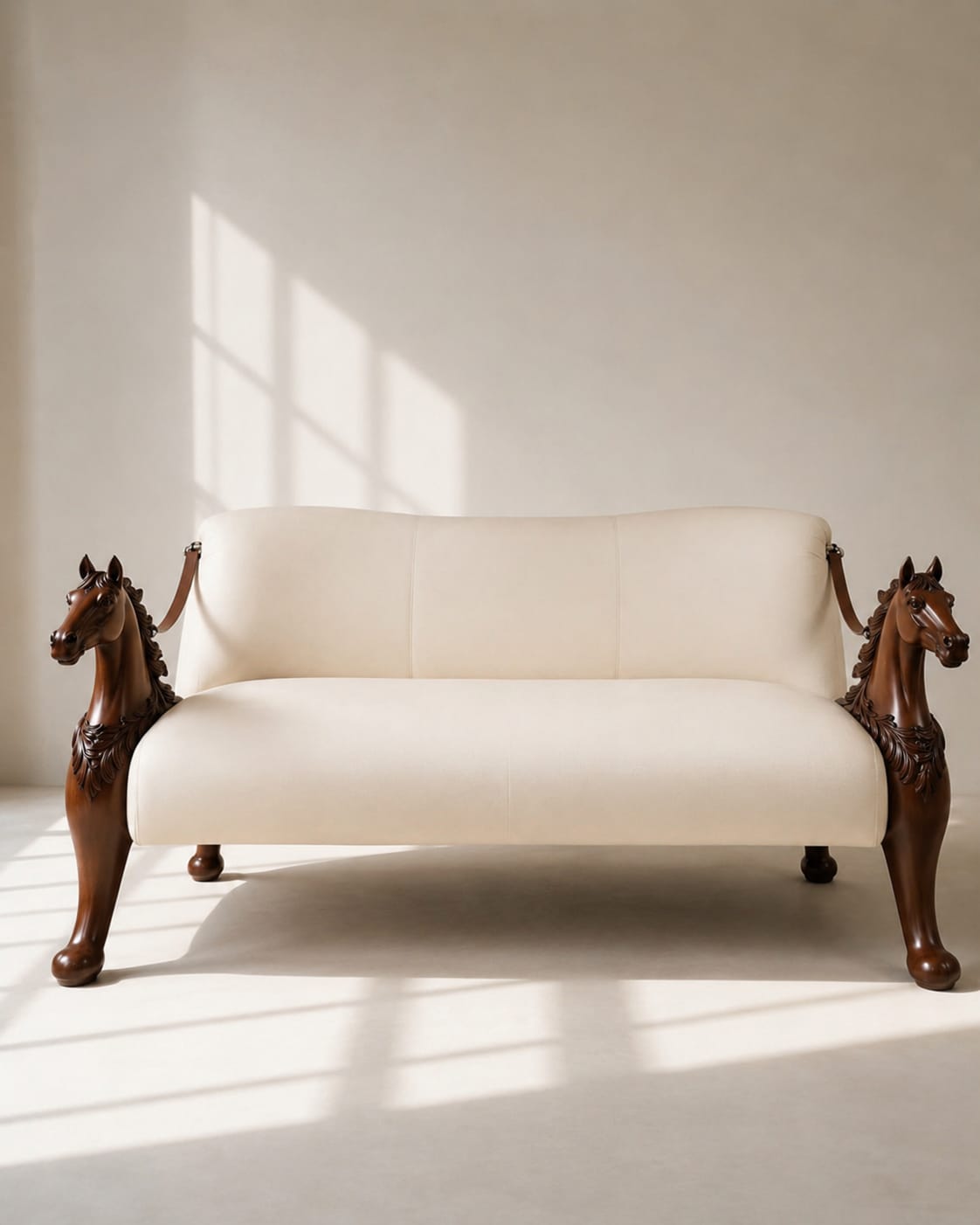
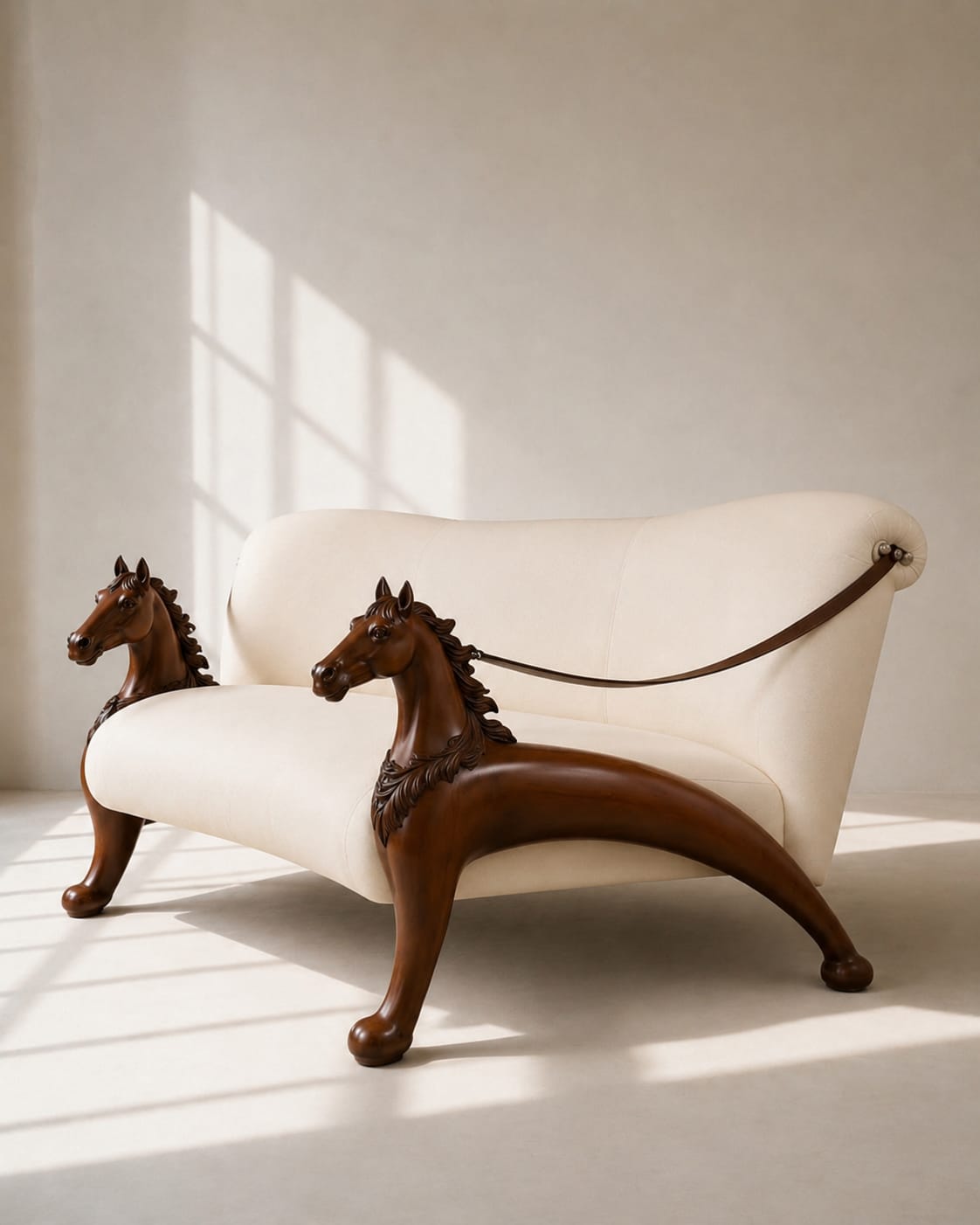
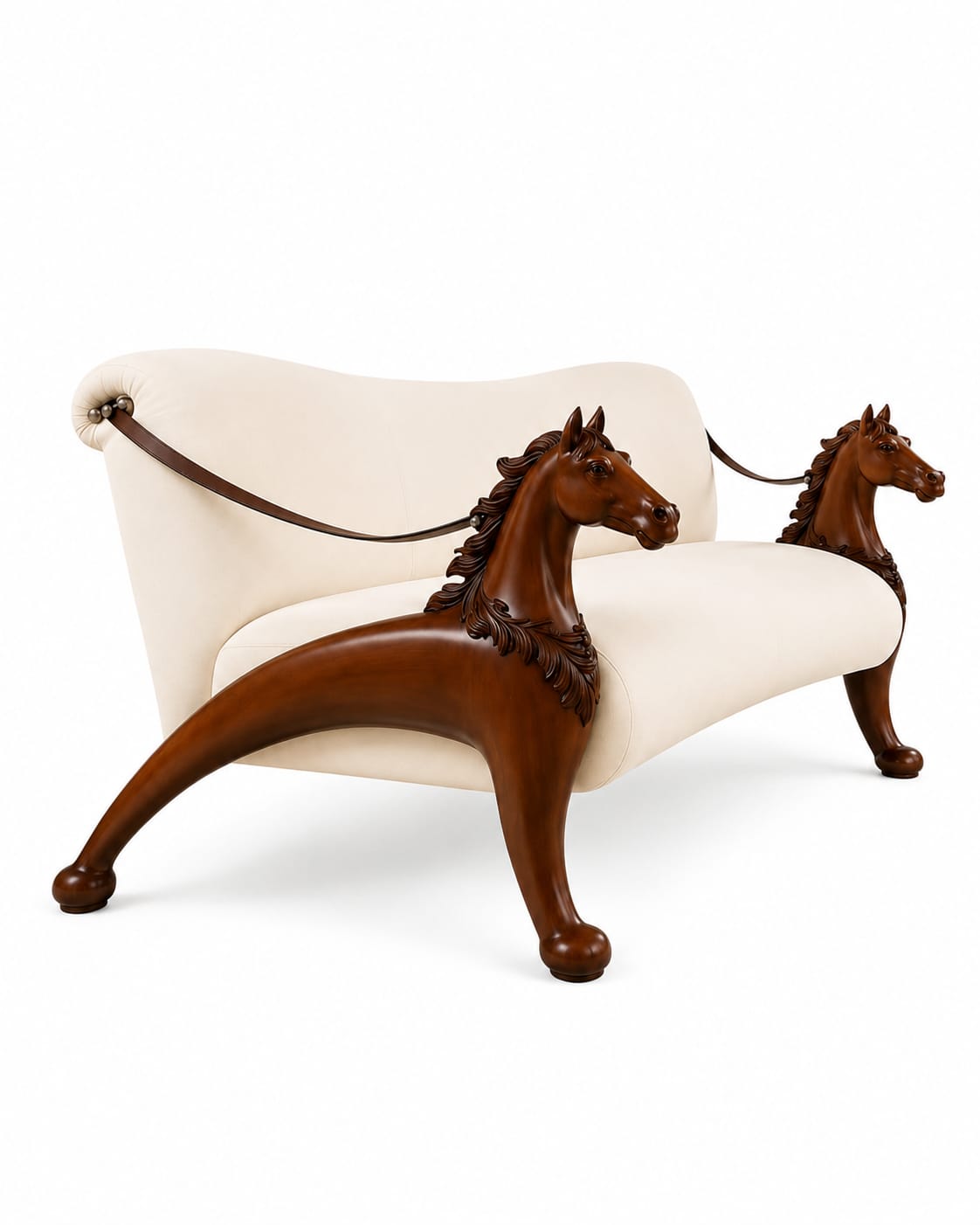
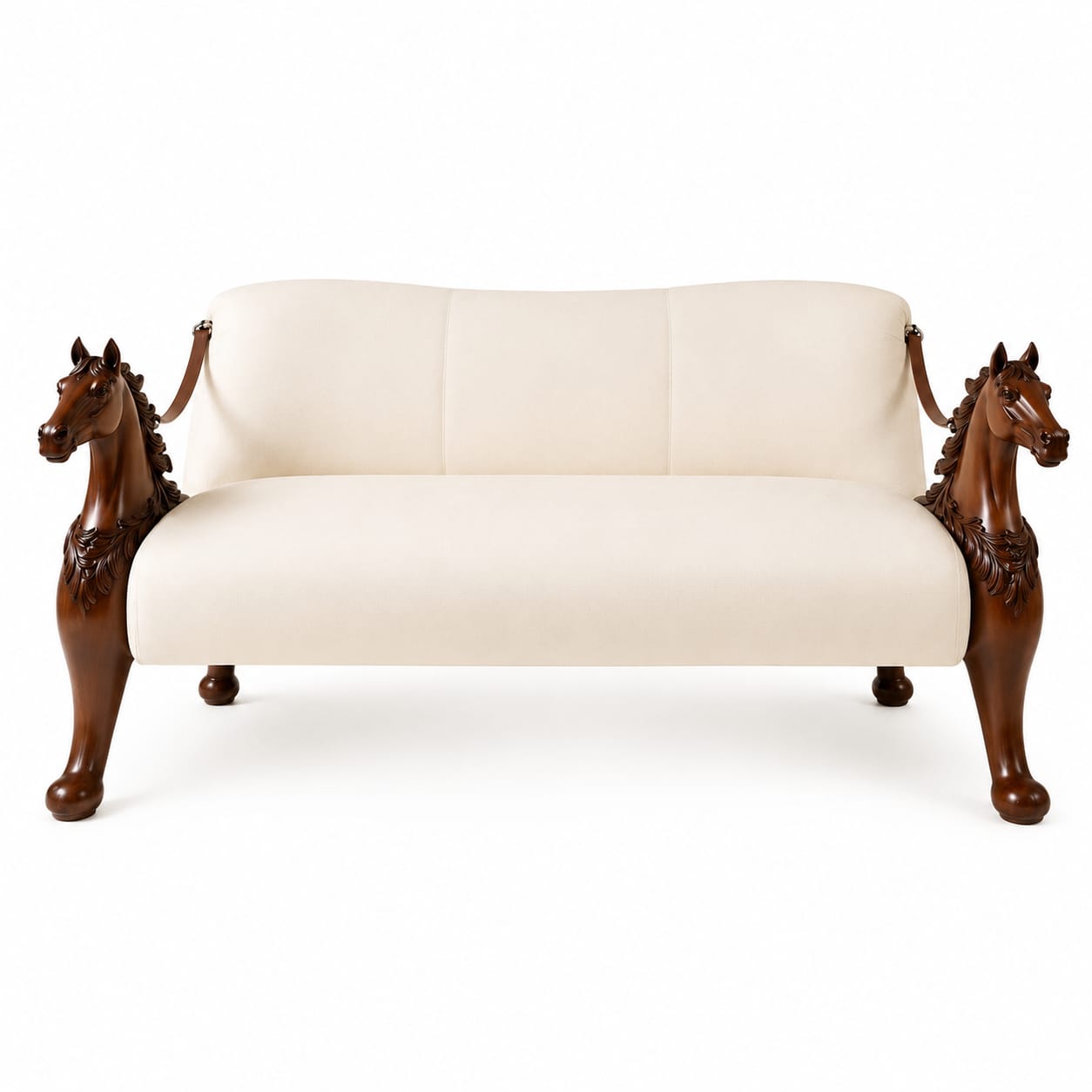
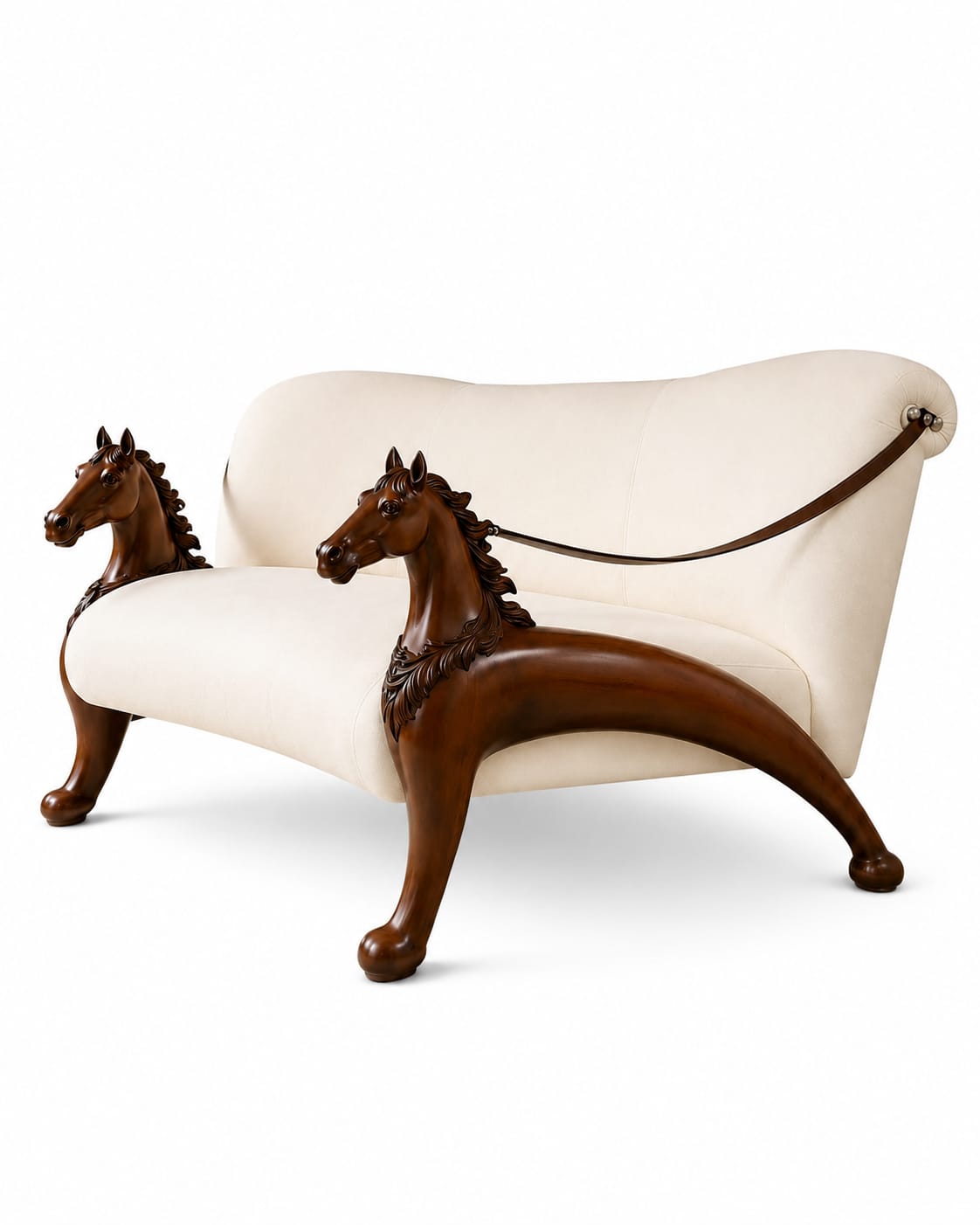
The Hand Carved Horse Sofa is a made-to-order statement sofa built by Maison Areeba, a verified workshop on 1Antiq. Its frame is carved by hand from seasoned solid wood, with a pair of sculpted horse heads forming the arm terminals and a carved, scrolled show-wood back rail running between them. It is priced at ₹4,50,000 (down from ₹6,50,000), rated 4.9 / 5 from 56 buyer reviews, ships free and tracked worldwide, and takes 2–3 weeks to build. Upholstery fabric, colour, wood finish, seat depth, length and carving density are all customisable.
Best for: vintage, antique, art deco, colonial, equestrian and maximalist interiors — drawing rooms, hotel lobbies, boutique receptions, farmhouse living rooms and any space that needs one object to carry the room.
Key specifications at a glance
| Detail | Specification |
|---|---|
| Product | Hand Carved Horse Sofa, Vintage Antique Living Room Furniture, Classic Home Decor |
| Studio | Maison Areeba (verified 1Antiq workshop) |
| Style | Vintage / antique revival with equestrian sculptural carving, art deco friendly |
| Frame material | Seasoned solid hardwood, hand-carved |
| Signature feature | Two fully hand-sculpted horse heads as arm terminals |
| Show wood | Carved back crest rail, arm scrolls, carved legs |
| Upholstery | Fabric of your choice; seat, back and inner arms padded |
| Seating | Sofa configuration; two-seat, three-seat and settee lengths available |
| Price | ₹4,50,000 (MRP ₹6,50,000) |
| International reference | approx. US$4,649 / €5,114 |
| Processing / lead time | 2–3 weeks, made to order |
| Shipping | Free, tracked, secure export crating |
| Rating | 4.9 / 5 from 56 buyer reviews |
| Returns | Not accepted (bespoke build); manufacturing defects and transit damage covered |
| Stock | 1 production slot open at the current lead time |
| Customisation | Fabric, colour, wood finish, size, carving detail, leg style |
What this sofa actually is, in plain language
Most sofas are upholstery with a hidden skeleton. This one is the opposite: it is a carved sculpture that happens to seat people.
Three things are happening at once:
- A carved show-wood frame. The visible timber — arms, crest rail, legs, front rail — is not trim glued onto a box. It is the structural frame itself, shaped and carved so that the wood is the design.
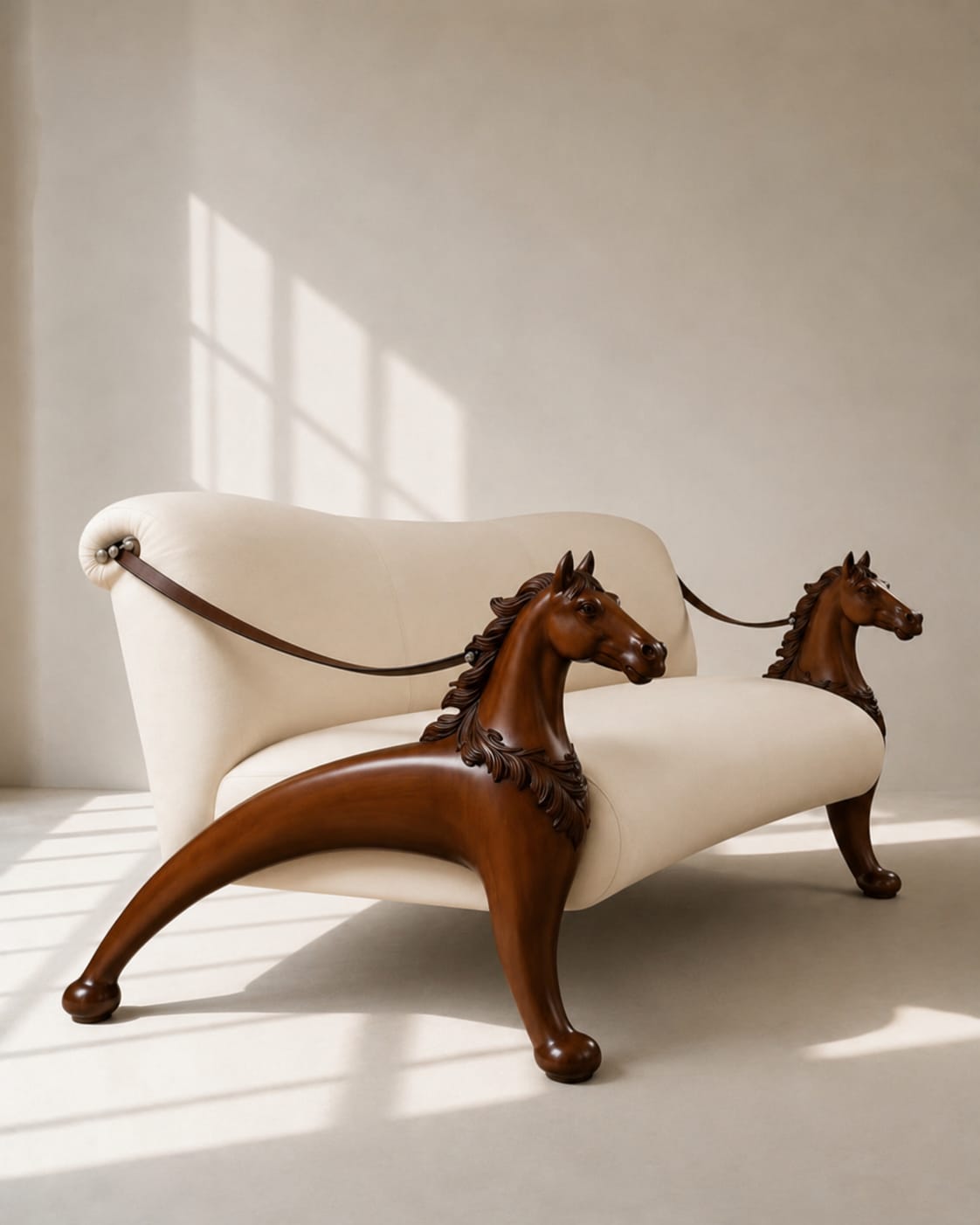
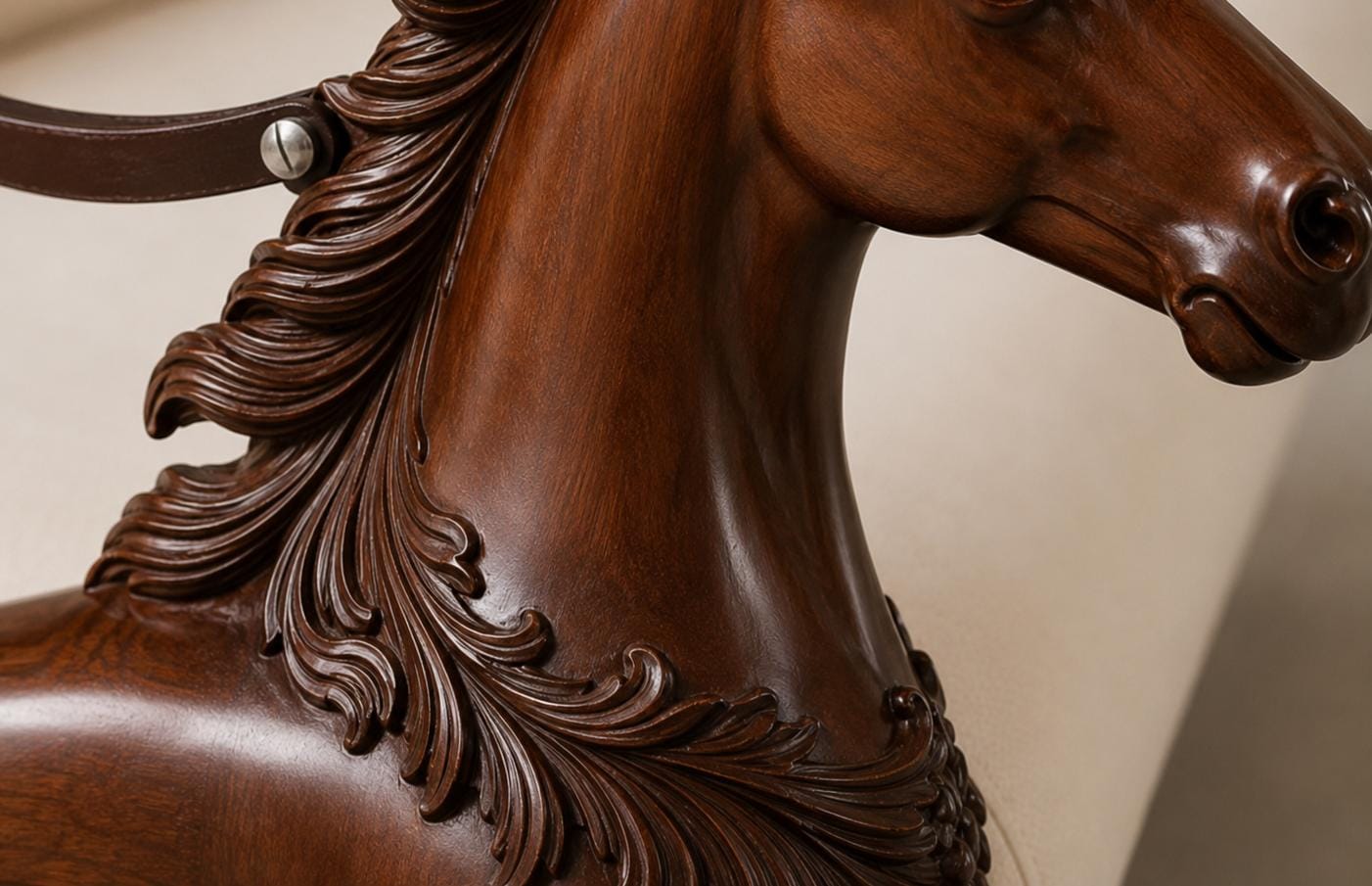
- Two sculpted horse heads. Each arm terminates in a horse head carved in the round from a single block: muzzle, nostrils, jawline, cheekbone, eye, brow, ears and a flowing mane that dissolves into the arm scroll. These are the hardest parts of the whole piece to make and the reason the sofa exists.
- Traditional upholstery. Seat, back and inner arms are built up with webbing, resilient support, foam and wadding, then covered in the fabric you choose and hand-finished at every show-wood junction.
Compare that with what is normally sold as an "antique carved sofa" online: a plywood or rubberwood carcass, resin ornaments cast in a silicone mould and glued on, machine-router "carving" that repeats identically on the left and right, and a gold or walnut spray finish over filler. You can spot the difference in ten seconds once you know what to look for — and this guide will teach you exactly that, whether or not you buy this particular sofa.
Why the horse, and why it never goes out of fashion
The horse is the oldest decorative motif in furniture that is still in continuous use.
Antiquity. Greek and Roman furniture used animal legs and heads on couches and thrones — lion paws, ram heads, horse protomes. The animal terminal was not decoration for its own sake; it borrowed the animal's status. A seat with a beast at the end of the arm said something about the person sitting in it.
Empire and Regency (early 1800s). Napoleonic France revived the classical vocabulary wholesale. Sphinxes, swans, lion monopodia and horse heads appeared on daybeds, sofas and chairs, usually gilded and paired with dark mahogany. The horse in particular carried military prestige.
Colonial India (18th–19th century). This is where the motif became a local craft tradition rather than an import. Indian workshops carving for European clients, and later for princely commissions, absorbed the animal-terminal idea and pushed it far past the European originals — deeper undercutting, more expressive faces, more movement in the mane. Rajasthani and Gujarati carving in particular treated the horse as a subject rather than a symbol.
Art Deco (1920s–30s). The horse got streamlined: fewer details, stronger planes, an emphasis on the arch of the neck. Deco horse furniture is arguably the most collectible version of the motif today.
Now. Equestrian decor is a permanent segment of the luxury interior market — it reads as heritage, land, sport and old money simultaneously. A carved horse sofa lands in that language instantly, without a single other reference in the room.
This piece sits closest to the colonial-Indian and Empire traditions: expressive, deeply carved, generous in scale, and paired with upholstery rather than left as bare wood.
How a hand-carved horse sofa is actually built
Understanding the sequence is the fastest way to understand the price. Here is the real order of work in the studio.
Stage 1 — Timber selection and seasoning
Carving timber has to be dense, close-grained and stable. Green or improperly dried wood will check (crack) along the grain months after delivery, and a crack across a horse's cheek is unrepairable in any invisible way. The workshop uses seasoned stock, and the blocks for the heads are chosen individually: no knots, no sapwood, no interlocked grain in the muzzle area where the section is thinnest.
A single arm head starts as a block substantially larger than the finished carving. Most of that timber becomes shavings on the floor. That waste ratio is a real, unavoidable cost in any sculptural carving.
Stage 2 — Frame joinery
Before any decorative work, the frame is built as a piece of structural furniture: seat rails, back posts, arm posts, stretchers. Joints are cut-and-fitted mortise and tenon, pinned and glued — not screwed butt joints, not dowel-and-cam fittings. The frame is dry-assembled and checked for square, then taken apart again for carving.
Stage 3 — Roughing the horse heads
The carver marks the profile on two faces of the block and removes bulk with an adze and large gouges. At this stage the head is a blocky, angular approximation — the neck arch, the length of the muzzle and the set of the ears are established. Everything about the final expression is decided here. Get the proportion wrong now and no amount of detail work later can rescue it.
Stage 4 — Modelling
Progressively smaller gouges and veiners develop the anatomy: the cheekbone, the jaw line, the flare of the nostril, the hollow above the eye, the lid, the brow ridge. This is where a hand-carved head separates itself permanently from a moulded one. A mould reproduces surfaces; a carver reproduces structure — the bone under the skin — and the eye reads that difference even when the viewer cannot name it.
Stage 5 — The mane
The mane is the show-off passage. It is undercut so that strands lift away from the neck and cast their own shadows, then flowed into the arm scroll so the sculpture and the furniture become one object rather than an ornament stuck onto a rail. Undercutting is the most fragile stage; a slip removes material that cannot be put back.
Stage 6 — Crest rail and secondary carving
The back rail, front rail and legs receive their scrollwork, foliage and beading. Because this is hand work, the left and right are near mirrors, not identical. Slight asymmetry is the signature of hand carving and is considered correct, not a defect.
Stage 7 — Sanding and finishing
The carving is worked through grits by hand — recesses included, which is slow — then sealed and finished. Finish options run from a natural oiled tone through mid-walnut and dark antique to distressed and gilded highlights. Antiquing is applied by hand into the recesses so the high points stay lighter, which is what gives carved wood its depth under normal room light.
Stage 8 — Upholstery
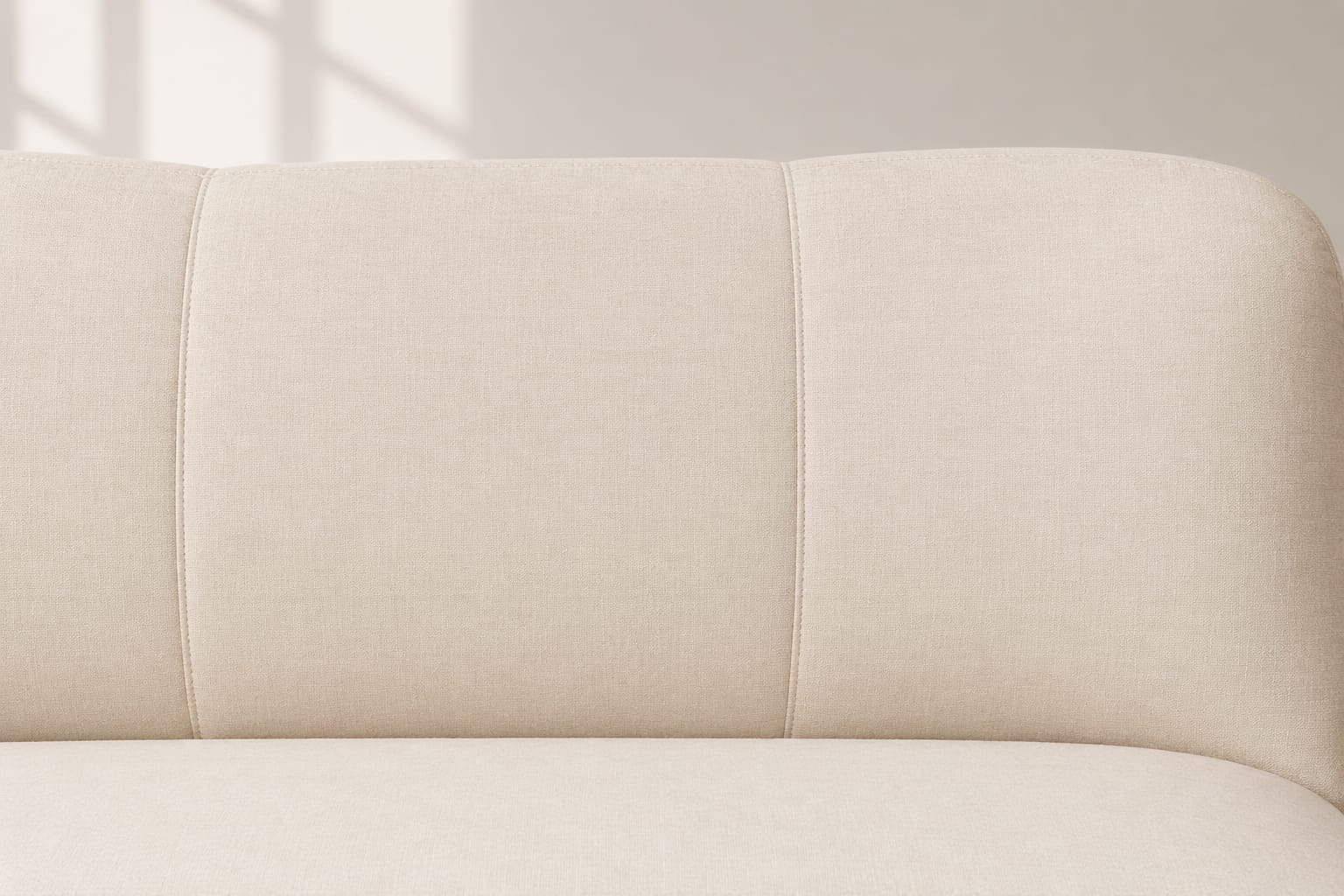
Webbing and support are fitted, foam and wadding are shaped to the frame, and the cover is cut, fitted and hand-finished. On show-wood furniture the upholstery has to die cleanly into the timber at every edge — that junction line is where cheap work always reveals itself.
Stage 9 — Inspection and crating
Final check, then export crating: corner protection, moisture barrier, foam wrap on every carved projection, and a rigid crate. Horse ears and muzzles are the vulnerable points in transit and are packed accordingly.
Hand-carved vs machine-carved vs resin: the honest comparison
| Factor | Hand-carved solid wood (this sofa) | CNC / router carved | Resin cast ornament |
|---|---|---|---|
| Depth of relief | Deep, fully undercut, carved in the round | Shallow to medium; limited by tool reach | Medium but hollow-backed |
| Left / right symmetry | Near-mirror, subtly individual | Perfectly identical | Perfectly identical |
| Anatomy | Bone structure modelled underneath | Surface-level only | Copied from one master |
| Tool marks | Fine gouge facets visible in recesses | Uniform ridged tracks | None; sometimes mould seams |
| Repairability | Recarvable, refinishable indefinitely | Refinishable, limited recarving | Chips reveal grey core; not repairable |
| Weight and sound | Heavy, dead solid, dull knock | Solid but lighter | Light, hollow knock |
| Lifespan | Multi-generational | Long if timber is solid | Ornament fails long before frame |
| Value over time | Appreciates as a craft object | Holds some value | Depreciates fully |
Quick field test: knock the arm terminal with a knuckle. Solid carved timber gives a dense, dull thud. Resin gives a light, hollow tap. Then look into the deepest recess of the mane with a torch — a carver's gouge facets are irregular and directional; a mould is smooth and uniform; a router leaves parallel stepped ridges.
Sizing, proportion and how to place it
A carved horse sofa is a primary object. It should not be squeezed against a wall between two other large items.
Planning rules that actually matter:
- Breathing room. Leave at least 200–250 mm of clear wall either side of the arms. The horse heads project outward visually; crowding them kills the sculpture.
- Viewing distance. The carving reads best from around 2–3 metres. If the only viewing position in your room is a metre away, request lighter carving density — deep undercutting at close range can feel busy.
- Circulation. Keep 750–900 mm of walkway in front, and 400–450 mm between the seat front and a coffee table.
- Ceiling. In rooms under about 2.7 m, choose a lower crest rail so the sofa does not visually crowd the wall.
- Doors, lifts and stairs. Measure your narrowest point in three dimensions before ordering, including the diagonal of a stairwell turn. Tell the studio the numbers at enquiry — length and arm profile can be adjusted at the design stage, which is far easier than solving it on delivery day.
Length guidance
| Configuration | Typical use | Room size suggestion |
|---|---|---|
| Two-seat settee | Bedroom foot-of-bed, entryway, hotel suite | From ~11 m² |
| Standard three-seat | Main drawing room seating | From ~16 m² |
| Extended / commissioned length | Lobby, gallery, large reception | 22 m² and up |
Exact dimensions are set per order because the piece is made to measure — confirm the final numbers in writing with the studio before production begins.
Choosing the upholstery: the decision that changes everything
The carving is fixed; the fabric is where you steer the whole personality of the piece.
Velvet (cotton or performance). The classic choice for carved show-wood furniture. Velvet's pile catches light in a way that complements carved timber, and deep jewel tones — emerald, oxblood, sapphire, aubergine — turn the sofa fully theatrical. Choose performance velvet if there are pets or children; standard cotton velvet marks with pressure.
Linen and linen blends. Softens the whole object and moves it toward a relaxed colonial or farmhouse register. Natural, oat, stone and dove grey let the carving be the only loud element. Linen creases; that is character, not a fault.
Leather and distressed hide. Pushes the sofa toward equestrian, club-room and library territory — arguably the most natural pairing with the horse motif. Tan, cognac and dark brown age beautifully. Note that leather is stiffer to work around tight show-wood junctions, so allow the studio extra time.
Damask, brocade and jacquard. The historically correct option for a European antique-revival piece. Very strong; needs a restrained room to avoid competing with the carving.
Plain vs pattern: if the carving is dense, go plain. If you have asked for lighter carving, a pattern can carry the piece.
Practical requests to make at enquiry:
- Ask for physical swatches. Screen colour is unreliable, especially for beiges, greys and greens.
- Ask for the Martindale / double-rub rating if the sofa will get daily use. Above 25,000 rubs is sensible for a living room.
- Ask whether seat cushions are loose or fixed, and specify your preference. Loose cushions can be flipped and rotated, extending life.
- Ask for the foam density. A firmer seat holds its shape far longer on a formal sofa than a soft one.
Styling the horse sofa in six different rooms
1. Classic drawing room. Deep velvet upholstery, a large patterned rug, a pair of restrained armchairs facing, table lamps with fabric shades, and one large mirror or oil painting above. Keep everything else quiet.
2. Art deco. Emerald or black velvet, brass or chrome accents, a lacquered geometric coffee table, fluted side tables, and a fan-motif mirror. The horse motif is deco-native, so this pairing needs no apology.
3. Colonial / heritage bungalow. Natural linen, planters, rattan side pieces, dark timber floors, ceiling fan, and botanical prints. The sofa becomes the anchor of a room that otherwise reads light.
4. Equestrian library. Tan leather, bookshelves, a green shaded desk lamp, brass tack details, and framed sporting prints. The most literal interpretation, and the most comfortable one.
5. Modern minimal contrast. Pale plaster walls, a concrete or micro-cement floor, one abstract canvas, and nothing else. In a plain room the sofa becomes an art object, and this is often the most striking presentation of all.
6. Hospitality reception. Lobby, boutique hotel, spa, bridal store, gallery. A single carved horse sofa in a reception area does more brand work than any signage — it is the object guests photograph.
Lighting is not optional. Carving needs raking light. A directional spot or picture light hitting the heads from an angle of roughly 30–45° creates the shadow that makes the sculpture read. Flat overhead lighting flattens carved furniture completely — this is the single most common reason people feel underwhelmed by carved pieces in their own homes after seeing them look magnificent in a studio photo.
Care, maintenance and long-term ownership
Carved show-wood furniture is easy to keep well and easy to ruin through a few specific mistakes.
Weekly
- Dust the carving with a soft natural-bristle brush, not a cloth. A cloth snags on undercut mane strands and can lift fibres or, over years, chip fine detail. A clean paintbrush is the correct tool and takes ninety seconds.
- Vacuum the upholstery on low suction with a brush head.
Monthly
- Wipe show wood with a barely damp, well-wrung soft cloth on the flat surfaces only, then dry immediately.
- Rotate and flip loose seat cushions so they wear evenly.
Twice a year
- Feed the timber. Apply a small amount of quality furniture wax or the finish-appropriate oil with a soft cloth, work it in, leave briefly, then buff. Use very little in the recesses — wax build-up in carved detail turns white and dulls the depth.
- Check joints for any movement and tighten any accessible fixings.
Never do these
- Never use silicone-based spray polish. It builds a film, attracts dust into carving and complicates future refinishing.
- Never use all-purpose household cleaners, ammonia, bleach or alcohol on the finish.
- Never place the sofa in direct sunlight for hours daily. UV fades both fabric and wood tone unevenly, and the exposed side will drift away from the shaded side within a couple of years.
- Never sit or lean on the arm terminals. They are structurally sound as arms but they are also the most detailed carving on the piece; treat them as sculpture.
- Never park it against an unvented heater, air-conditioner outflow or radiator. Rapid humidity swings are what crack solid timber.
Environment. Aim for a stable indoor humidity of roughly 40–60%. In extremely dry heated interiors, a room humidifier protects carved hardwood significantly. In coastal humidity, ensure air movement behind the piece rather than sealing it flat against a damp wall.
Long term. Because everything is solid timber and traditional upholstery, this sofa is fully serviceable. Upholstery can be replaced entirely in twenty years without touching the frame. Finish can be stripped and reapplied. A damaged carving detail can be recarved by a competent restorer. That is the practical definition of an heirloom: every component is repairable.
Pricing: what ₹4,50,000 is actually paying for
The sofa is listed at ₹4,50,000, reduced from ₹6,50,000. Roughly, the money splits like this:
- Sculptural carving labour (largest share). Two horse heads carved in the round, plus crest rail, arms, front rail and legs. This is weeks of skilled hand time by a carver who took years to reach this level. There is no way to compress it.
- Timber. Seasoned, defect-free carving stock, bought in blocks large enough for the heads, with a high waste ratio.
- Frame joinery. Traditional cut joints, dry-fitted and pinned.
- Upholstery. Materials plus the hand-finishing required around show wood, which is far slower than upholstering a plain box.
- Finishing. Multi-stage sealing, toning, hand-applied antiquing and buffing.
- Free tracked worldwide shipping and export crating. Crating a carved piece properly is a genuine cost, and it is included.
What it is not paying for: retail floor space, middlemen, or a brand licence. You are buying directly from the workshop through 1Antiq.
Cost comparisons for context
| Option | Typical spend | What you get |
|---|---|---|
| Mass-market "carved" sofa | ₹40,000 – ₹1,20,000 | Engineered frame, resin or router ornament, sprayed finish, 5–10 year life |
| Mid-market reproduction | ₹1,50,000 – ₹3,00,000 | Some solid wood, mostly machine carving, factory upholstery |
| This piece | ₹4,50,000 | Solid hardwood, fully hand-carved sculpture, bespoke upholstery, multi-generational |
| Genuine period antique with equivalent carving | ₹8,00,000+ and rising | Provenance and age, but unknown structural condition, non-negotiable size, near-certain need for reupholstery |
The honest summary: against a genuine antique you gain size control, fabric control, structural certainty and a warranty on defects, and you give up age and provenance. Against a mass-market copy you give up nothing except the price gap, and you gain an object that will outlive you.
Where you can reduce cost legitimately: ask for a shorter two-seat settee, request lighter secondary carving on the crest rail and legs while keeping the horse heads fully detailed, and choose a mid-range fabric. Ask the studio to quote these variations before you commit.
Ordering, lead time, shipping and returns
Lead time. Processing and crafting run 2–3 weeks from confirmation. Highly customised carving, unusual lengths or specialty imported fabric can extend this — get the revised timeline in writing before paying.
Shipping. Free, tracked and worldwide, in secure export packing. Ask for the crate's external dimensions and gross weight in advance so you can plan access and, if needed, arrange help on delivery day.
Delivery day checklist
- Photograph the crate on arrival, before opening, from all sides.
- Unpack in a clear space, not in a corridor.
- Inspect the horse ears, muzzles and mane undercuts first — these are the vulnerable points.
- Check every show-wood-to-fabric junction line.
- Confirm the fabric matches your approved swatch in daylight.
- Report any issue to the studio the same day with photographs.
Returns. Because every piece is built to your specification, returns are not accepted. That is standard for bespoke furniture and it is why the pre-order stage matters. Manufacturing defects and transit damage are handled directly by the studio.
Questions worth asking before you pay
- Can I see progress photographs of the roughed and modelled horse heads before finishing?
- Which timber species is being used for the heads specifically?
- Are the seat cushions loose or fixed, and what is the foam density?
- What is the fabric's rub count and is a performance version available?
- What are the exact finished external dimensions, including arm projection?
- What is the crate size and weight?
- What is covered under defect handling, and for how long?
A workshop that answers all seven precisely is a workshop worth buying from. Maison Areeba's 4.9 rating across 56 reviews reflects a studio that engages at this level of detail.
Who should buy this — and who should not
Buy it if:
- You want one object that defines a room and you are prepared to build around it.
- You value hand craft and can tell — or want to learn to tell — the difference between carving and casting.
- You are furnishing a heritage home, a hotel lobby, a boutique reception or a gallery-like space.
- You collect equestrian, colonial, deco or antique-revival pieces.
- You want furniture your grandchildren can reupholster rather than replace.
Do not buy it if:
- You need a soft, sink-into, television-watching sofa. This is a formal seat.
- Your room is small and already contains several strong pieces.
- You move house frequently and cannot commit to a heavy, dimensionally fixed object.
- You need it in under two weeks.
- You are not comfortable with a no-returns bespoke purchase.
There is no shame in the second list. The wrong buyer for a sculptural sofa is simply a buyer with a different brief.
Buyer's checklist before you confirm
- Measured room, doorways, stairwell diagonal and lift interior
- Chosen configuration length and confirmed final external dimensions in writing
- Requested and received physical fabric swatches
- Confirmed fabric rub count and performance option
- Confirmed wood finish tone against a physical sample, not a screen
- Agreed carving density on secondary areas
- Confirmed cushion type and foam density
- Agreed to receive in-progress carving photographs
- Confirmed lead time, crate size, weight and delivery access
- Read and accepted the no-returns bespoke policy
- Planned the directional lighting that will make the carving read
Frequently asked questions
Are the horse heads carved from solid wood or moulded? They are carved by hand from solid seasoned hardwood, worked in the round from a single block per head. They are not resin castings and not glued-on appliqués. You can request in-progress photographs of the roughed and modelled heads before finishing to verify this yourself.
Will the two horse heads look exactly the same? Not exactly, and that is correct. Hand carving produces near-mirror pairs with tiny individual differences in the mane flow and expression. Perfectly identical heads are the signature of a mould or a CNC router, not of a carver.
Can I choose a different fabric and colour? Yes. Fabric, colour, wood finish, size, carving detail and leg style are all customisable. Request physical swatches before confirming, because screen colour is unreliable for beiges, greens and greys in particular.
Is it comfortable, or is it purely decorative? It is genuinely usable seating with padded seat, back and inner arms, built in the tradition of a formal drawing-room sofa. It is firmer and more upright than a modern lounge sofa by design — say so at enquiry if you want a softer seat and the studio can adjust foam density.
How long does it take to make and deliver? Processing and crafting take 2–3 weeks, after which the sofa ships free with tracked, secure export crating. Heavier customisation can extend the build; confirm the revised timeline in writing.
Will it fit through my door or up my stairs? Usually, but this is a solid one-piece carved frame rather than a knock-down flatpack, so measure first. Send the studio your narrowest doorway, corridor and stairwell-turn dimensions at enquiry, because length and arm profile can be adjusted at the design stage.
How do I clean the carving? Use a soft natural-bristle brush weekly, never a cloth in the undercut areas. Wax or oil the show wood twice a year with very little product in the recesses, and avoid silicone sprays and household cleaners entirely.
Can this made-to-order sofa be returned? No. Bespoke pieces are non-returnable because they are built to your exact specification. Manufacturing defects and transit damage are handled directly by the studio, so photograph the crate on arrival and inspect the carved projections first.
Is it worth the price compared with a genuine antique? Against an antique of equivalent carving quality you pay less, choose your own size and fabric, and get a structurally sound new frame with defect cover. You give up age and provenance. Against a mass-market reproduction you pay considerably more and get an object that is repairable and inheritable rather than disposable.
The bottom line
The Hand Carved Horse Sofa is not a sofa with decoration on it. It is a piece of figurative sculpture that has been engineered to seat people, built by hand in seasoned solid wood, upholstered to your specification, and delivered free and tracked anywhere in the world in two to three weeks.
At ₹4,50,000 it costs roughly what a mid-range factory sofa set costs — and it belongs in a completely different category of object. Buy it if you want the room to have a centre. Light it properly, brush the carving, wax it twice a year, and it will still be doing its job long after everything else in the room has been replaced.